Manual Agent Dependence Slows Growth
The Hidden Trap in India’s Export-Import Game: How Manual Agent Dependence Slows Growth
The Hidden Trap in India’s Export-Import Game: How Manual Agent Dependence Slows Growth

Once Indian exporters and importers start getting buyers and personalized market insights, they confront another deep-rooted hurdle: Dependence on fragmented, manual workflows and intermediaries — which slows everything down, increases costs, creates errors, and kills competitiveness. This problem is less talked about but extremely real — and it’s one of the biggest reasons India’s export ecosystem stays behind global standards.
The Export-Import System Is Still Manual, Fragmented & Agent-Dependent
Today, most exporters and importers in India rely heavily on multiple external agents to execute trade operations. These include: Customs Brokers (CHAs) — handling customs paperwork
Freight Forwarders — booking and managing logistics
Shipping & Logistics Agents — coordinating transport and delivery
Local Agents & Middlemen — arranging inspections, documentation, and follow-ups
This dependency exists because government systems, ERP links, and trade processes are not fully digitized or integrated, forcing businesses to outsource each step manually. In practical terms, this means: Exporters request quotes from several agents
Compare rates and timelines manually
Coordinate documents, approvals, and shipments via WhatsApp and email
Wait for each intermediary to complete their stage
Hope that paperwork is correct
This fragmented chain introduces delays, errors, high costs, and opacity in pricing — with no one party accountable end-to-end.
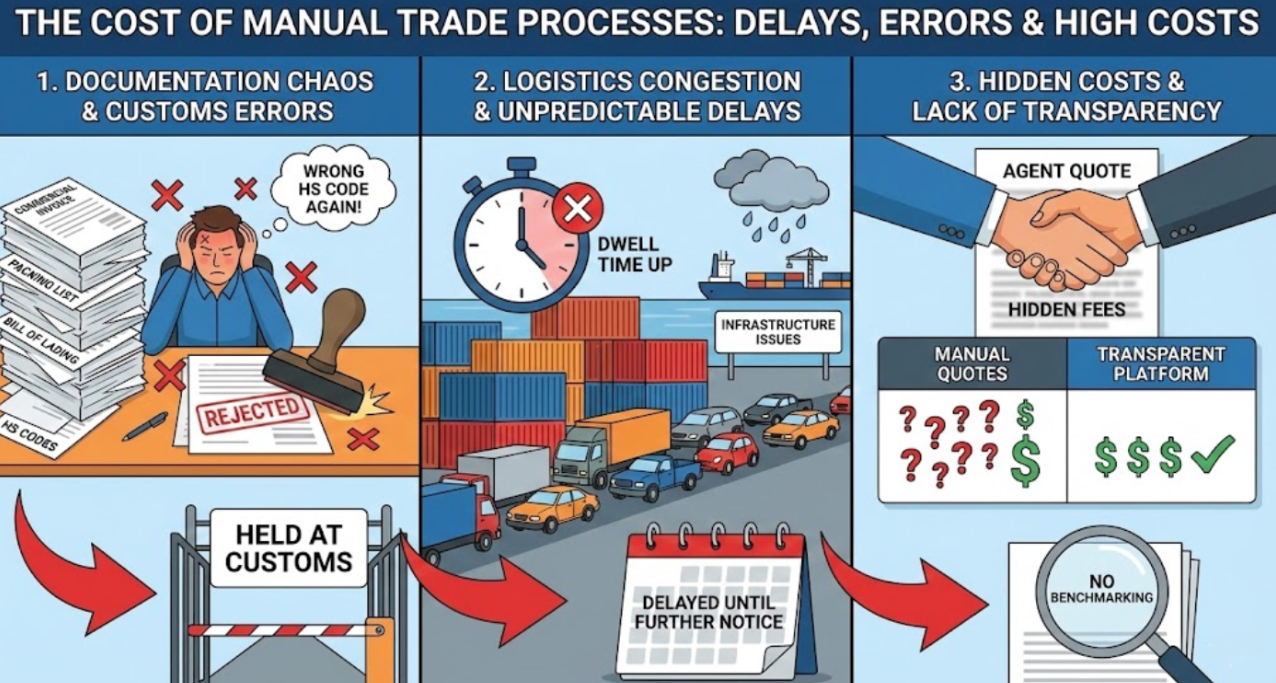
Manual Processes Cause Delays, Errors & High Costs
This Is the Next Frontier — And It’s Bigger Than Buyer Discovery
Once exporters obtain buyers and insights, the next big game in global trade becomes: Digitizing workflows, reducing manual dependencies, and creating transparent end-to-end processes. This is critical because: Smart discovery without smart execution still leads to delays.
Reducing agent dependency without process automation still leads to inefficiency.
Exporters and importers need a system where process intelligence and execution come together.
Platforms that can integrate: Document validation
Pricing transparency
Agent marketplace with benchmarks
Customs pre-clearance
Logistics coordination
Status tracking
ERP integrations
…will unlock the next wave of trade efficiency and global competitiveness.
1. Error-Prone Documentation & Customs Clearances
Export and import procedures require a long list of documents such as: Commercial invoices
Packing lists
Bills of lading
Certificates of origin
HS codes
Shipping bills
Any small mistake — wrong value, HS code error, missing field — can cause cargo to get held at customs, leading to delays, fines, and re-filing efforts. This isn’t a rare exception — it’s a structural inefficiency because: Each document is prepared by a different agent
They are often emailed or messaged back and forth
There’s limited validation or integration with customs systems
2. Logistics Delays & Unpredictable Turnaround
Logistics coordination is another pain point: Dwell and detention times increase at ports due to inefficiencies.
Manual planning and poor synchronization between agents lead to backlogs and congestion.
For example, periodic infrastructure issues such as flooding and poor depot conditions at major Indian ports like Mundra have repeatedly disrupted cargo flows, leading to stranded containers and rising costs. This is not because ports can’t handle volume — but because the current processes are not optimized with end-to-end visibility and predictability.
3. Higher Costs and Lack of Transparency
When exporters and importers get multiple agent quotes manually: There is no standardized pricing
Hidden fees and markups are common
Businesses cannot compare real cost-to-benefit effectively
There’s no transparency mechanism to benchmark services
In many cases, larger agents charge significant premiums simply because there’s no alternative real-time comparison platform — reinforcing the agent-driven ecosystem instead of eliminating inefficiency.
The Opportunity Lost: Traditional Workflows Are Non-DigitalThis Is the Next Frontier — And It’s Bigger Than Buyer Discovery
Once exporters obtain buyers and insights, the next big game in global trade becomes: Digitizing workflows, reducing manual dependencies, and creating transparent end-to-end processes. This is critical because: Smart discovery without smart execution still leads to delays.
Reducing agent dependency without process automation still leads to inefficiency.
Exporters and importers need a system where process intelligence and execution come together.
Platforms that can integrate: Document validation
Pricing transparency
Agent marketplace with benchmarks
Customs pre-clearance
Logistics coordination
Status tracking
ERP integrations
…will unlock the next wave of trade efficiency and global competitiveness. Despite ongoing digitization efforts in exports, much of the trade execution layer remains non-automated and offline. Key institutional elements — like customs clearance, logistics scheduling, document validation, and shipment tracking — still depend on manual handoffs between: Agents
Exporters
Importers
Customs
Logistics firms
This fragmented workflow leads to cascading inefficiencies that cost businesses time, money, and competitive edge in cross-border markets.
Why This Matters: Systemic Resistance to Scaling
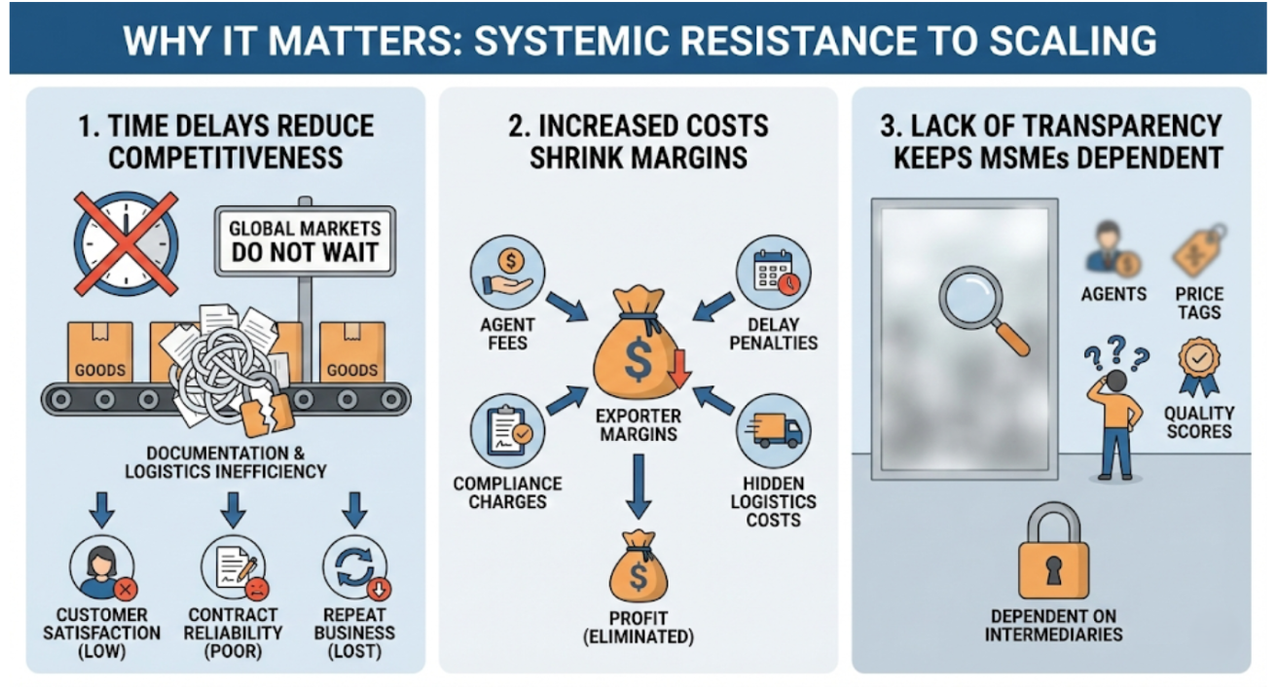
Even after MSMEs find international buyers or get relevant insights, the process bottleneck still stops them from scaling. Here’s how this inefficiency impacts the broader ecosystem:
- Time Delays Reduce Export Competitiveness Global markets do not wait — especially for goods that can be sourced faster elsewhere. Every day of delay due to documentation or logistics inefficiency impacts: Customer satisfaction
Contract reliability
Repeat business
- Increased Costs Shrink Margins Exporters must bear: Agent fees
Delay penalties
Compliance charges
Hidden logistics costs
This diminishes their cost advantage in global markets, sometimes eliminating profit entirely. 3. Lack of Transparency Keeps MSMEs Dependent Smaller exporters, in particular, have: No real comparison between agents
No structured price transparency
No validated quality scores
Therefore, they remain dependent on intermediaries, often without knowing if they are getting efficient deals.
This Is the Next Frontier — And It’s Bigger Than Buyer Discovery
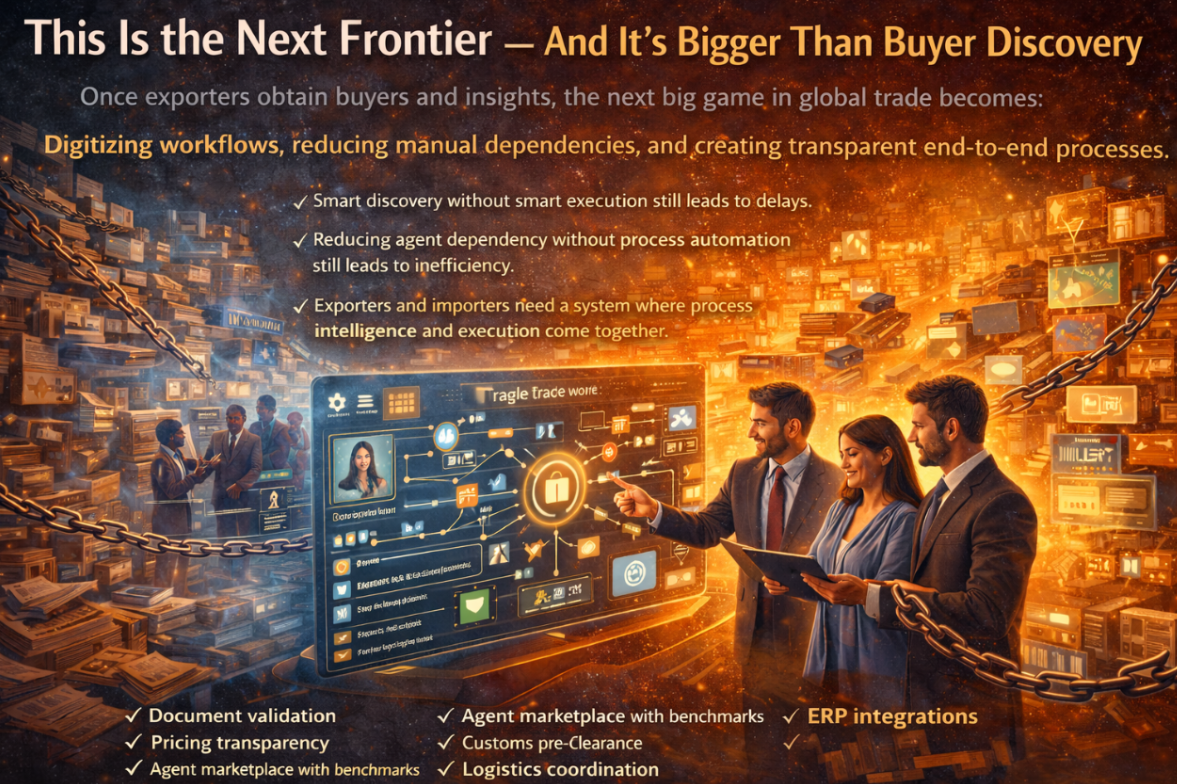
Once exporters obtain buyers and insights, the next big game in global trade becomes: Digitizing workflows, reducing manual dependencies, and creating transparent end-to-end processes. This is critical because: Smart discovery without smart execution still leads to delays.
Reducing agent dependency without process automation still leads to inefficiency.
Exporters and importers need a system where process intelligence and execution come together.
Platforms that can integrate: Document validation
Pricing transparency
Agent marketplace with benchmarks
Customs pre-clearance
Logistics coordination
Status tracking
ERP integrations
…will unlock the next wave of trade efficiency and global competitiveness.
Conclusion: The Current System Is a Fragmented Manual Bottleneck
India’s exporters and importers have traditionally fought: Manual workflows
Fragmented agent dependency
Non-transparent pricing
Delays and errors
Cost inefficiencies
These are not occasional pain points — these are structural inefficiencies that reduce India’s competitive edge in global trade. The next transformation — after buyer and data discovery — must be about: Digitizing execution, automating workflows, removing opacity, and leveling the operational playing field. When this is solved, exporting will become not just possible — but efficient, competitive, and scalable for businesses of all sizes.