India’s Port & CFS Bottleneck
India’s Ports Aren’t Broken by Capacity — They’re Broken by Coordination
##What Indian Ports & CFSs Really Struggle With — A Plain, Brutal Inventory (vs. Rotterdam & Singapore) India’s ports have improved a lot in the last decade, yet they still lag many world-class ports on operational predictability, digital integration, and yard/terminal productivity. Below I list every major problem, explain why it happens, and note how world-class ports avoid it. Quick context: Indian ports are improving (turnaround has come down in recent years) but persistent structural issues — data fragmentation, manual workflows, weak node connectivity, and infrastructure gaps — cause avoidable dwell time, detention/demurrage costs, and lost competitiveness.
1 High Container Dwell Time & Long Turnaround for Certain Cargoes
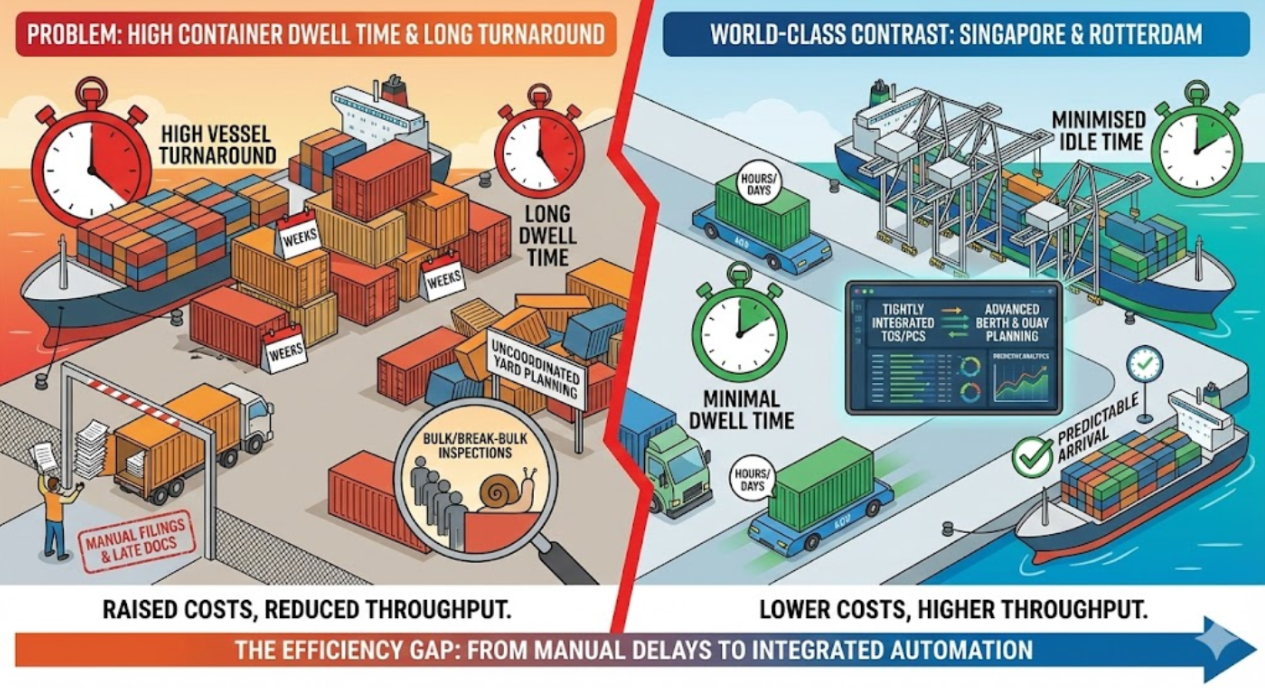
Problem: Containers and vessels often spend more time in port than necessary (import container dwell, export processing, vessel turnaround), raising costs and reducing throughput. Why: manual filings, late arrival of documentation, uncoordinated yard planning, and inspections cause delays. At some non-major terminals dry-bulk and break-bulk can have extremely long dwell times. World-class contrast: Singapore & Rotterdam use tightly integrated TOS/PCS + advanced berth and quay planning to minimise vessel idle time and container dwell.
2 Fragmented Node Connectivity (PCS, TOS, Customs, GST, NLP integration gaps)
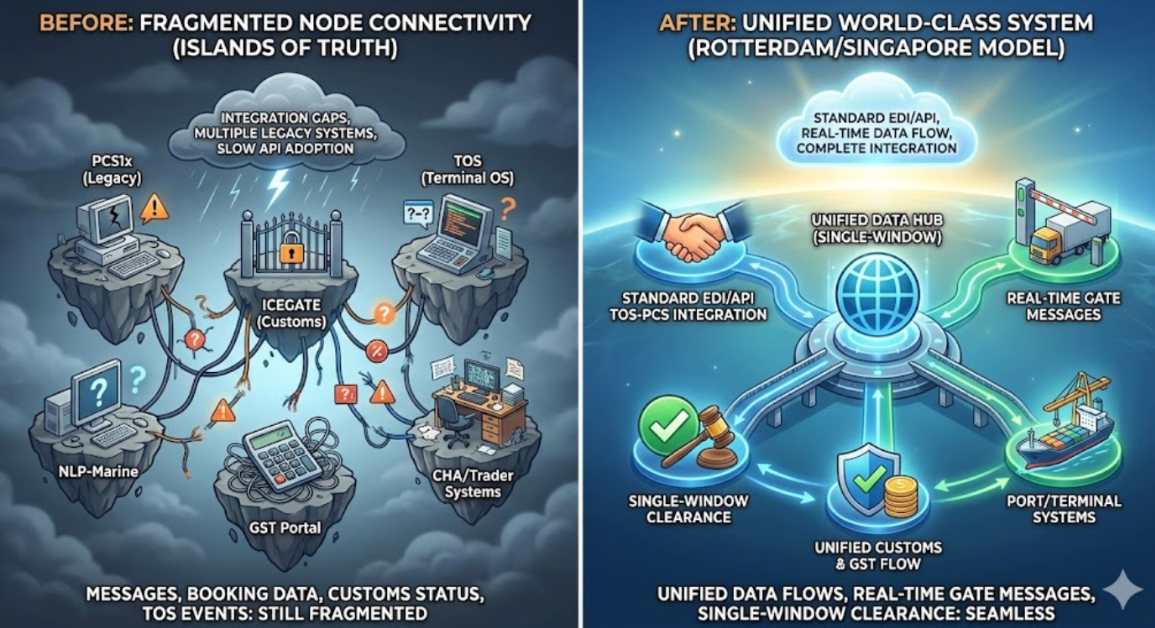
Problem: Messages, booking data, gate messages, customs status, TOS events and trader/CHA communications are still fragmented across PCS systems, CHAs, freight forwarders and legacy port systems. Integration is uneven between PCS1x, ICEGATE, TOS and the National Logistics Portal (NLP-Marine). Why: multiple legacy systems, different vendors, partial adoption across terminals, and slow API/standards adoption lead to “islands of truth.” World-class contrast: Rotterdam/Singapore run unified data flows with standard EDI/API TOS-PCS integration, real-time gate messages, and single-window clearance.
3 Manual & Repetitive Documentation (Garbage-in → Garbage-out)
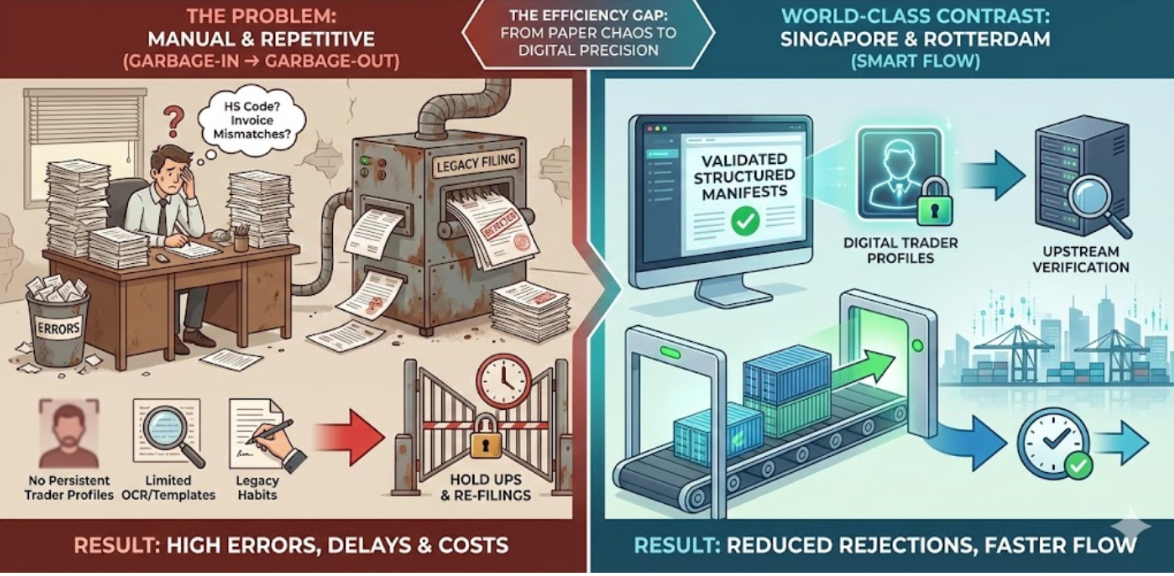
Problem: Repeated manual entry and non-standardised document formats cause errors (HS codes, invoice mismatches), hold ups and re-filings — the classic “garbage in, garbage out.” Why: lack of persistent trader profiles, limited OCR/structured templates adoption, and legacy filing habits. World-class contrast: Top ports enforce validated structured manifests, digital trader profiles, and upstream verification to reduce rejections.
4 Weak Terminal Operating System (TOS) Adoption & Maturity
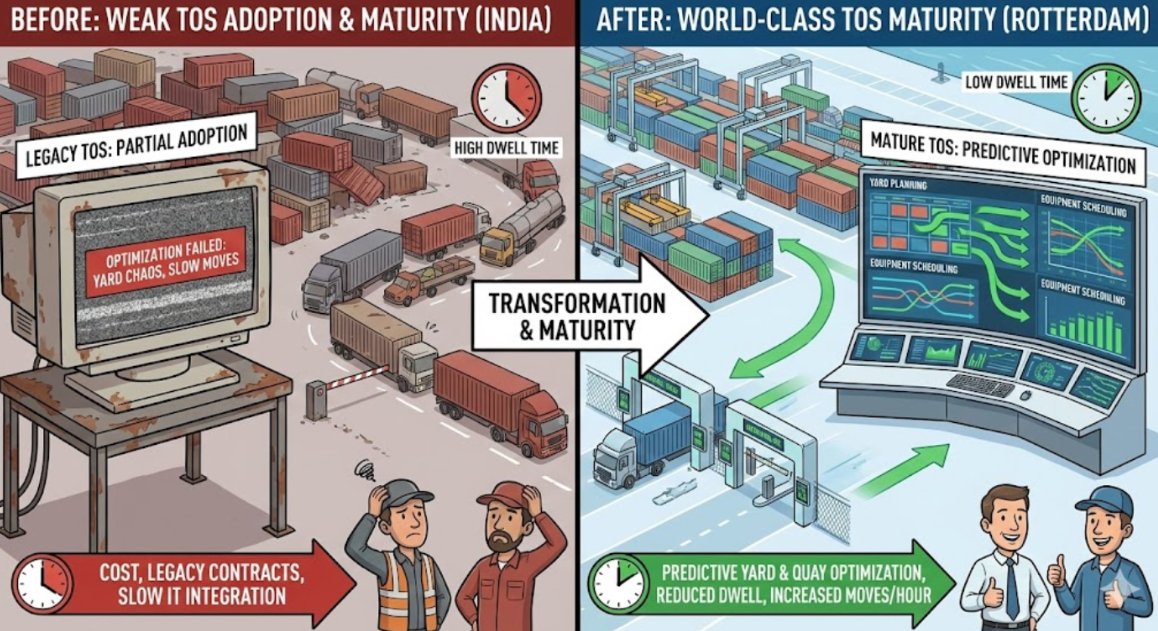
Problem: Some Indian terminals lack modern TOS capability or operate with partial/legacy TOS that do not optimize yard planning, equipment scheduling, or gate flows. Why: Cost, legacy operator contracts, and slow integration of operations & IT. World-class contrast: Rotterdam and leading terminals use mature TOS with predictive yard and quay optimization to reduce dwell and increase moves/hour.
5 Poor Yard & Empty Container Depot (ECD) Infrastructure — weather and drainage problems
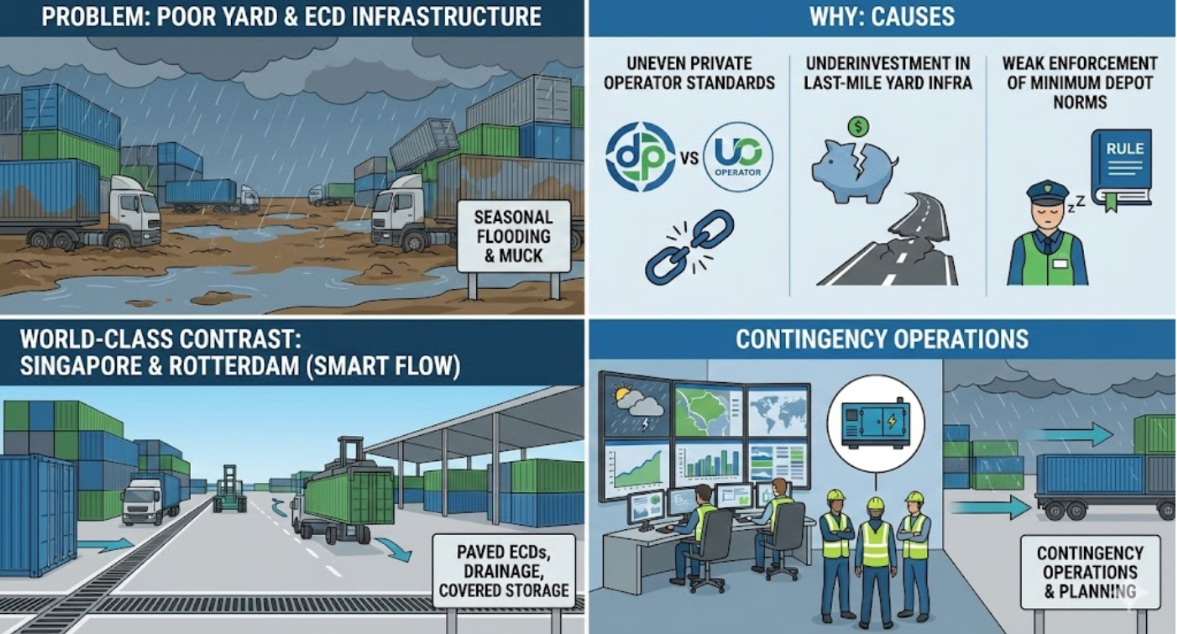
Problem: ECDs, yards and approach roads at several ports are inadequately paved/drained; seasonal flooding and muck can immobilize container moves (recent examples exist). Why: uneven private operator standards, underinvestment in last-mile yard infra, and weak enforcement of minimum depot norms. World-class contrast: Top ports invest heavily in paved ECDs, drainage, covered storage and contingency operations.
6 Gate Congestion & Slow Gate In / Gate Out (GIGO) Processes
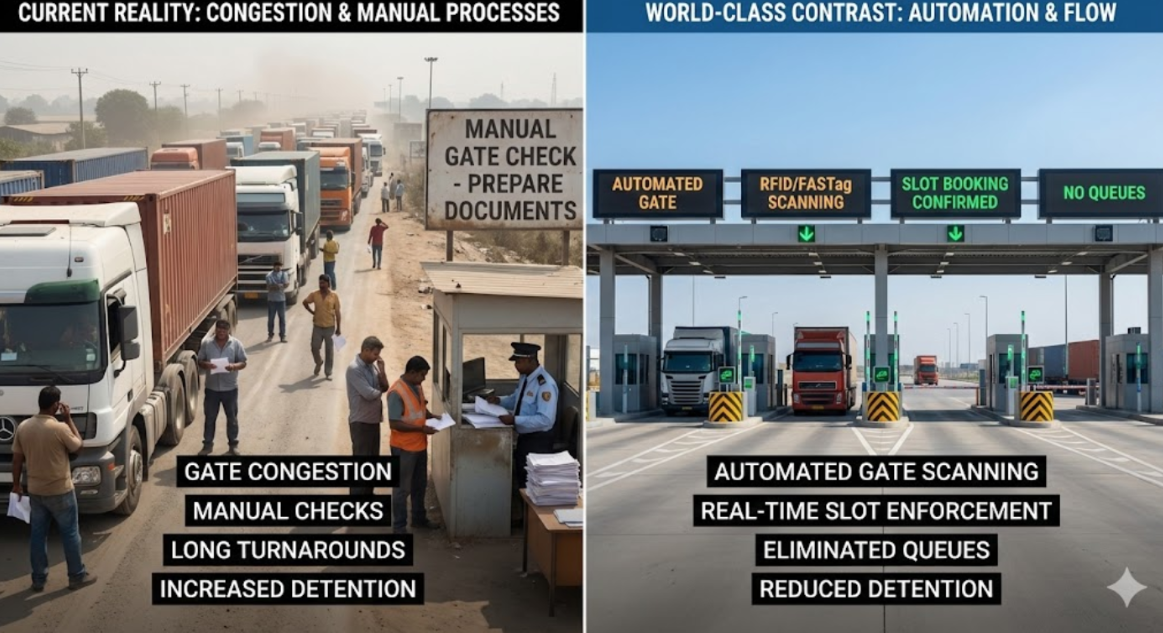
Problem: Gate queueing, manual checks and duplicate paperwork produce long truck turnarounds and increased detention/demurrage exposure. Why: limited electronic gate automation, poor sequencing, and lack of slot/ETA discipline. World-class contrast: Ports like Singapore use slot booking, automated gate scanning (RFID/FASTag equivalents), and real-time slot enforcement to eliminate queues.
7 Lack of Real-Time Visibility for Stakeholders
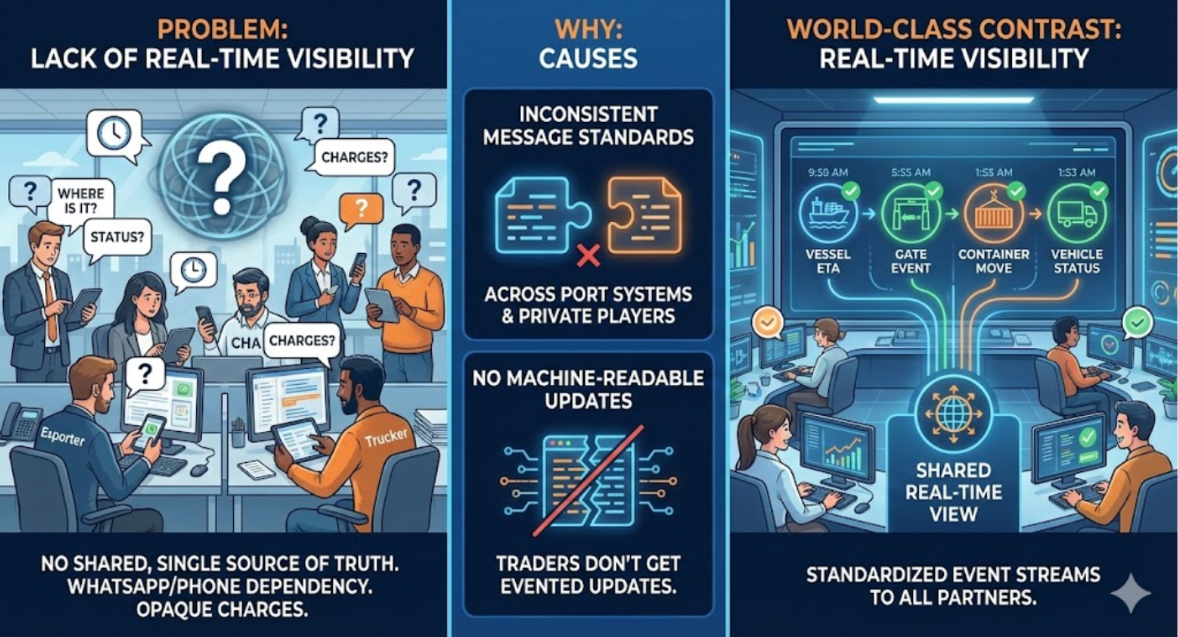
Problem: Exporters, importers, CHAs and truckers lack a shared, real-time single source of truth for container/vehicle/filing status. This fuels WhatsApp/phone dependencies and opaque charges. Why: inconsistent message standards across port community systems and private players; traders don’t get machine-readable, evented updates. World-class contrast: World-class ports publish standardized event streams (vessel ETAs, gate events, container moves) to all partners in real time.
8 High Demurrage & Detention Costs (and disputed accountability)
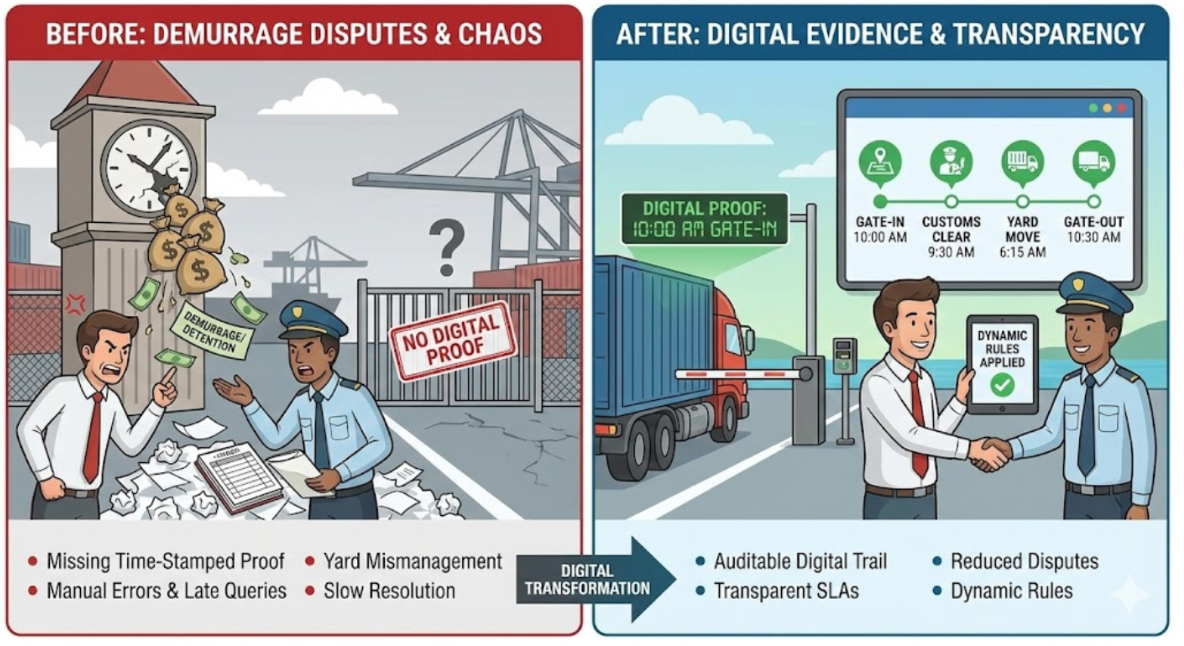
Problem: Demurrage/detention frequently accrues because of coordination failures; disputes over responsibility are common. Lack of auditable timestamps makes resolution slow. Why: missing time-stamped digital proof (gate-ins/gate-outs), late customs queries, and yard mismanagement. World-class contrast: With digital evidence trails and transparent SLAs, leading ports reduce disputes and apply dynamic demurrage rules.
9 Poor Hinterland & Multimodal Connectivity (Road / Rail / Inland Water)
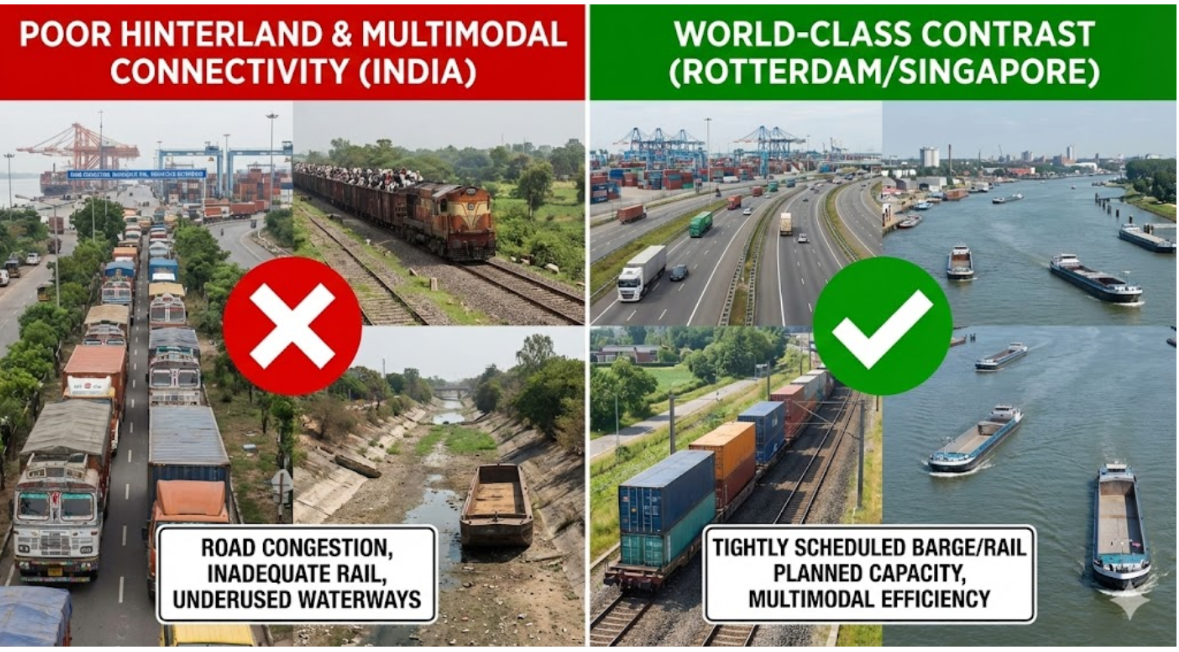
Problem: Road congestion, inadequate rail evacuation, and underused inland waterways increase port dwell and truck idling. India’s hinterland linkages vary greatly by port and corridor. Why: incomplete investment in last-mile highways/rail loops, capacity constraints and modal coordination issues. World-class contrast: Rotterdam/Singapore tightly schedule barge/rail movements; hinterland capacity is planned in tandem with port expansions.
10 Variable Operator Performance Across Major vs Non-Major Ports
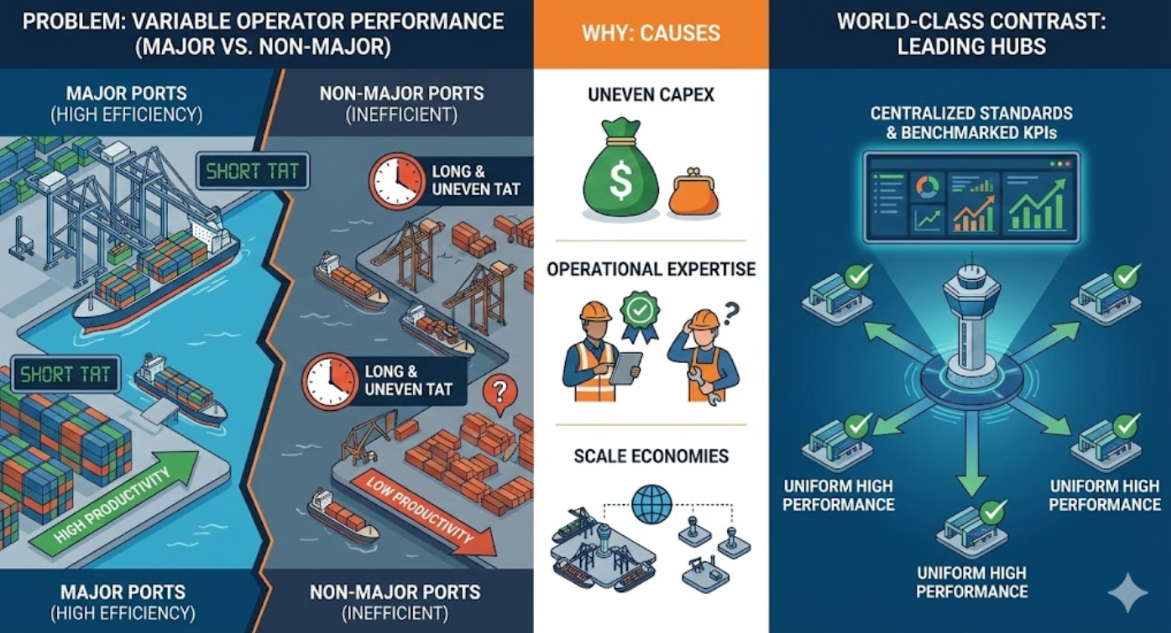
Problem: Non-major ports and smaller terminals show far bigger inefficiencies, uneven TAT and lower equipment productivity than top major ports. Why: uneven capex, operational expertise, and scale economies across the port network. World-class contrast: Leading hubs centralize standards and benchmark KPIs aggressively across terminals.
11 Incomplete Single Window & PGA (Partner Government Agency) Integration
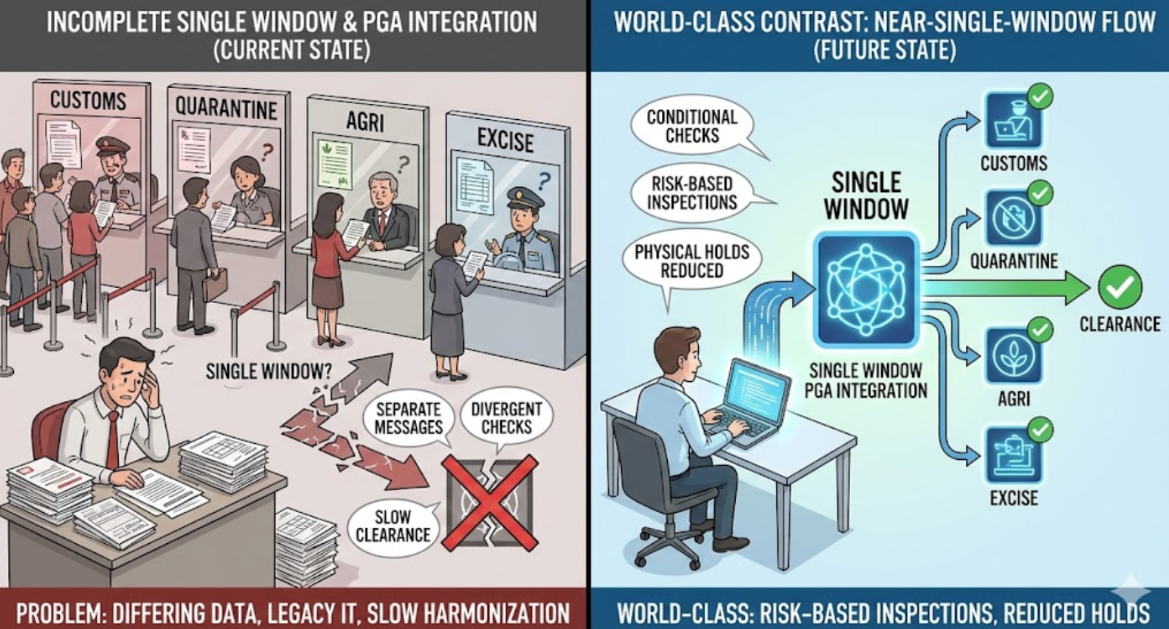
Problem: Multiple PGAs (customs, quarantine, agri, excise, etc.) still require separate messages or hold divergent checks, slowing clearance. Why: differing data requirements, legacy agency IT, and slow harmonization of message schemas. World-class contrast: Best ports have near-single-window PGA flows with conditional checks and risk-based inspections to reduce physical holds.
12 Low Data Quality & Lack of Persistent Trader Profiles
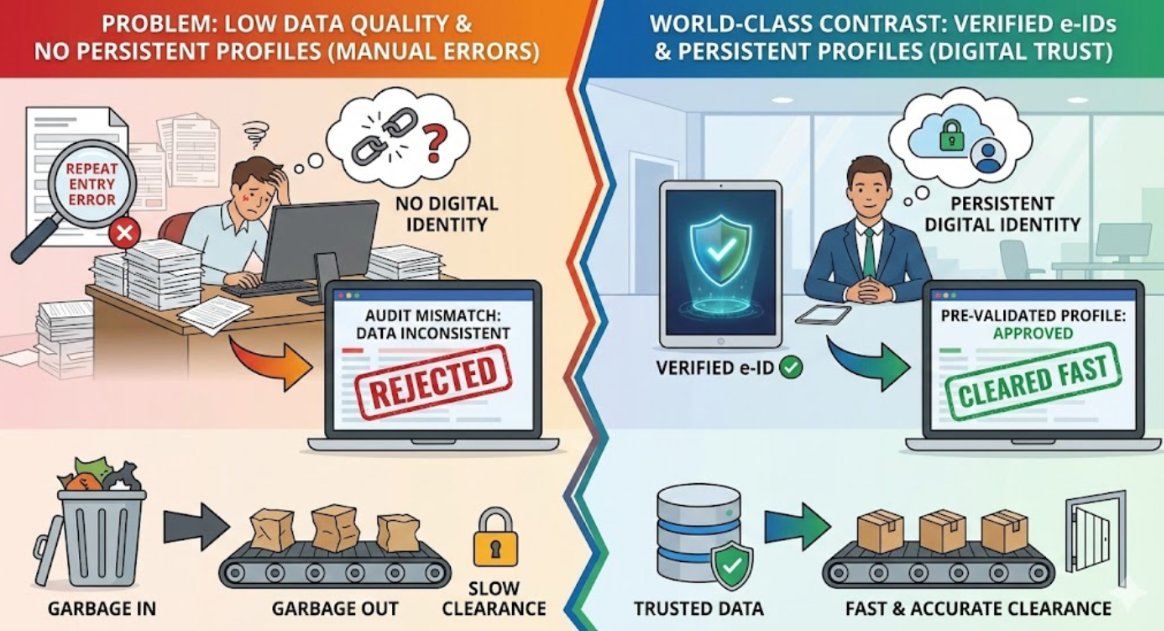
Problem: No authoritative, reusable exporter/importer/profile data model across filings causes repeat entry errors and audit mismatches. Why: traders don’t have persistent digital identities with validated documents integrated into port systems. World-class contrast: Global leaders use verified e-IDs, persistent profiles and pre-validation so filings clear faster.
13 Process & Governance Fragmentation (public/private ownership complexity)
Problem: Multiple stakeholders (port authorities, private terminals, shipping lines, depot operators, CHAs) often lack aligned KPIs and contractual accountability, causing operational friction. Why: legacy concession models, differing commercial incentives, and weak performance enforcement. World-class contrast: Leading ports align contracts with strong KPI enforcement and shared performance dashboards.
14 Skilled Labour & Digital Capability Gaps
Problem: Terminal automation demands new skills; many operators are mid-transition with manual fallback processes. Why: training gap, incremental IT adoption, and reluctance to change entrenched workflows. World-class contrast: Advanced ports invest heavily in change management and operate primarily automated processes.
15 Weather & Contingency Readiness (monsoon, flooding, natural shocks)
Problem: Monsoon flooding, poor drainage at ECDs and insufficient contingency planning disrupt operations and damage cargo. Recent events show real impact. Why: insufficient infrastructure resilience and uneven enforcement of minimum depot standards. World-class contrast: Top ports have hardened infrastructure, covered storage, drainage systems and disaster playbooks.
Why These Problems Exist
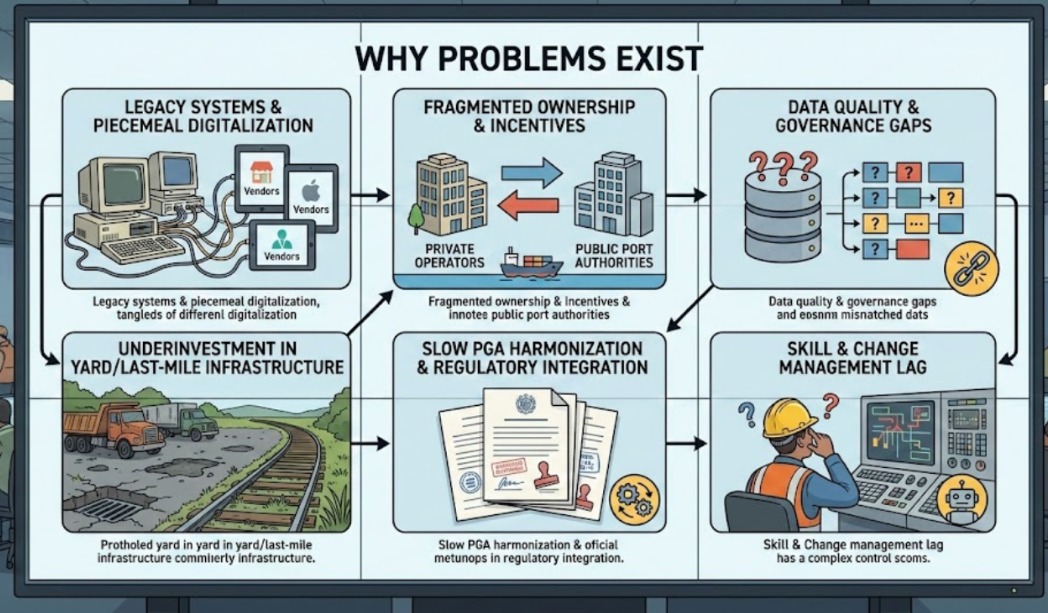
Legacy systems and piecemeal digitalization — different vendors, partial APIs.
Fragmented ownership & incentives — private operators and public port authorities often optimize locally, not systemically.
Data quality & governance gaps — lack of standardized profiles and validations.
Underinvestment in yard/last-mile infrastructure — drainage, paving, rail loops.
Slow PGA harmonization & regulatory integration — multiple checks without unified risk frameworks.
Skill & change management lag — automation requires retraining and governance.
What World-Class Ports Do Differently
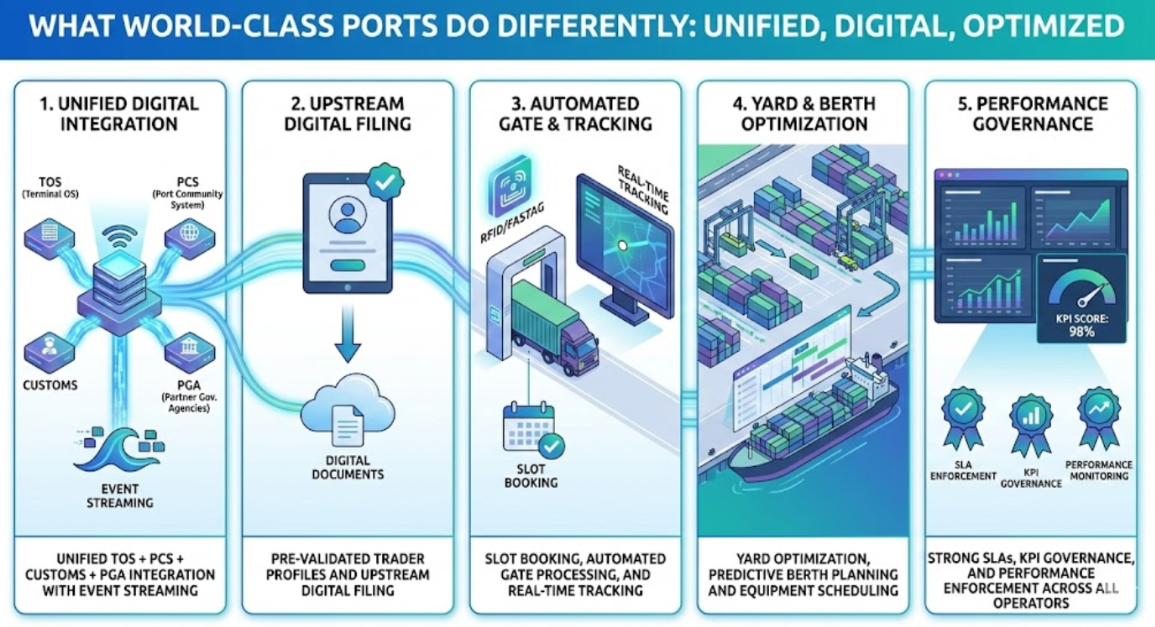
Unified TOS + PCS + Customs + PGA integration with event streaming.
Pre-validated trader profiles and upstream digital filing.
Slot booking, automated gate processing (RFID/FASTag style), and real-time tracking.
Yard optimization, predictive berth planning and equipment scheduling.
Strong SLAs, KPI governance, and performance enforcement across all operators.