uber for logistics
From Fragmented Execution to Coordinated Trade Infrastructure
What Impact We Are Creating by Solving This Problem
From Fragmented Execution to Coordinated Trade Infrastructure
India’s export–import ecosystem does not suffer from lack of intent, policy, or infrastructure. It suffers from poor coordination between systems, stakeholders, and data. By building ManuDocs, we are not just solving exporter or importer pain points — we are creating measurable impact across logistics, CFSs, ports, and national trade operations. This is the impact that emerges when execution becomes intelligent and connected.
1. Pre-Filled Documentation → Clean, Standardized Data at the Source
Today, one of the biggest operational issues in trade execution is data inconsistency: Same information entered multiple times
Different formats across documents
Errors introduced at every manual touchpoint
ManuDocs solves this by: Creating structured exporter/importer profiles
Pre-filling documentation using OCR and templates
Validating data before submission
Sharing standardized data across stakeholders
Impact: High-quality, standardized data flows downstream — once, correctly. This directly addresses the long-standing “garbage in, garbage out” problem in trade systems.
2. CFSs & Ports Receive Data Before Trucks Arrive
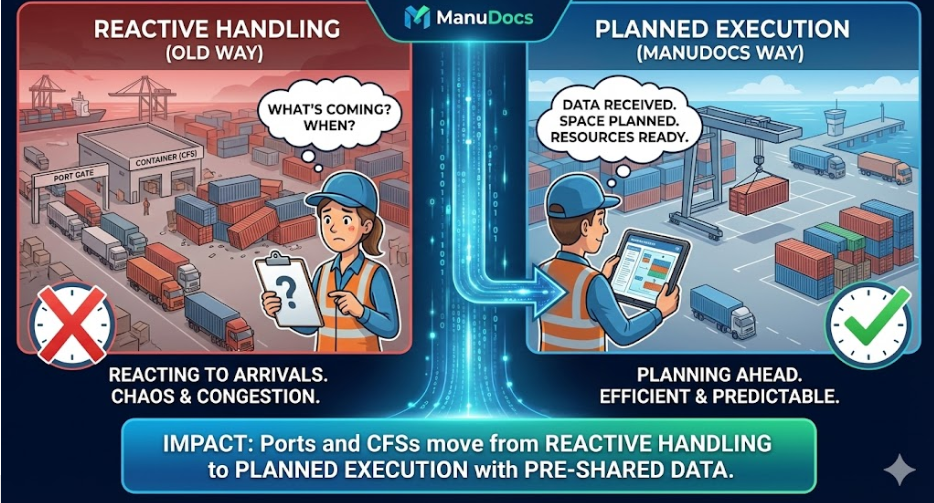
Because documentation and shipment details are prepared in advance: CFSs know what cargo is coming
Ports know when trucks will arrive
Terminals know which containers belong where
This changes port operations fundamentally. Instead of reacting to arrivals, CFSs and ports can: Plan yard space
Prepare handling resources
Sequence operations efficiently
Impact: Ports and CFSs move from reactive handling to planned execution.
3. Dedicated Routes, Terminals & Stop Points for Trucks
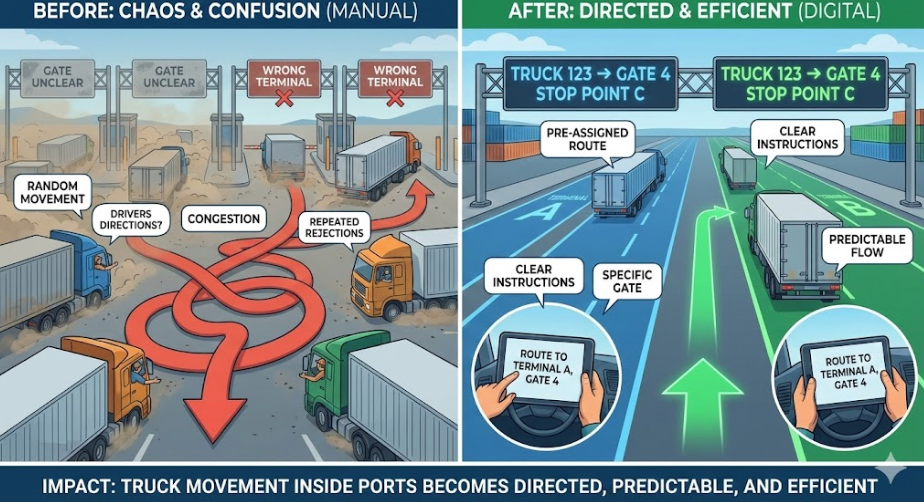
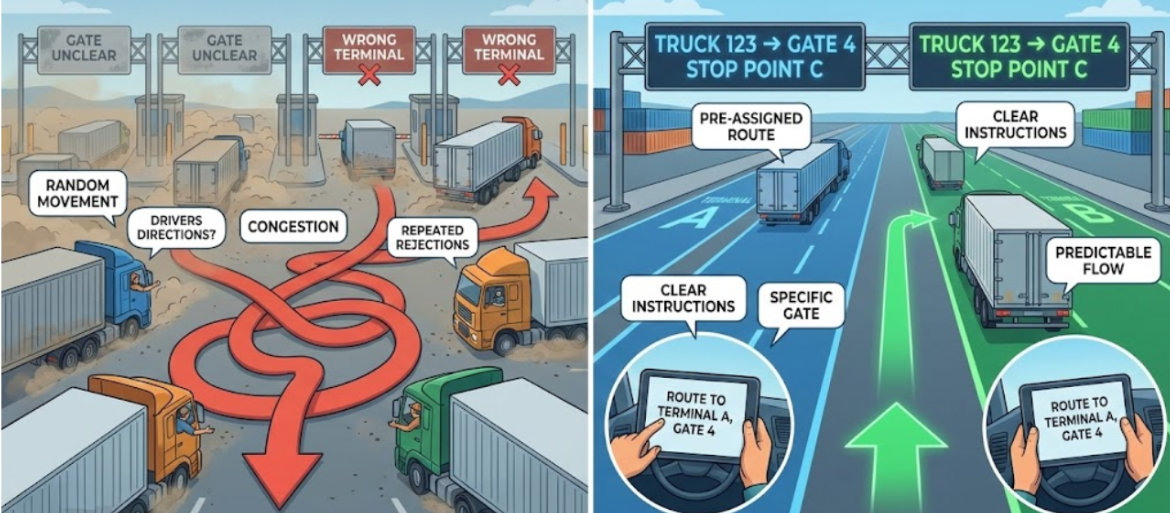
With pre-shared data and system integration: Trucks are assigned specific terminals
Drivers receive clear instructions on:
Where to go
Where to stop
Which gate to enter
No trial-and-error inside port premises
This eliminates: Random movement inside ports
Congestion at wrong terminals
Repeated gate rejections
Impact: Truck movement inside ports becomes directed, predictable, and efficient.
4. Reduced Turnaround Time (TAT) Across the System
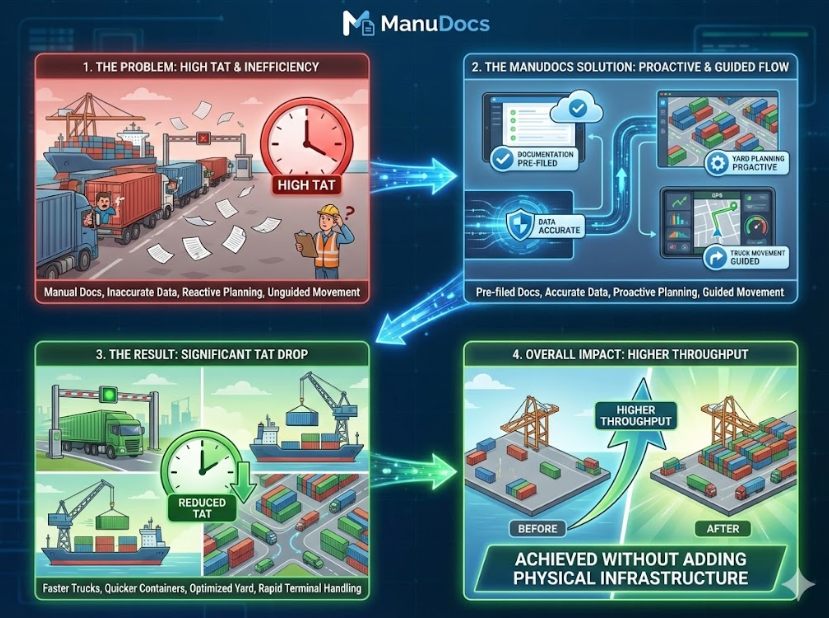
When: Documentation is pre-filed
Data is accurate
Yard planning is proactive
Truck movement is guided
…the result is inevitable: ➡ Turnaround time drops significantly This applies to: Trucks
Containers
Yard operations
Terminal handling
Impact: Higher throughput without adding physical infrastructure.
5. Lower Detention & Demurrage — With Digital Proof
Detention and demurrage often arise due to: Delays caused by poor coordination
Disputes over who caused the delay
Lack of time-stamped evidence
ManuDocs introduces: Digital gate-in / gate-out records
Time-stamped movement logs
Proof-based execution history
Impact: Fewer disputes
Lower detention and demurrage
Faster resolution when issues arise
This saves real money, not just time.
6. Optimizing Port, CFS & Warehouse Operations — Not Just Logistics
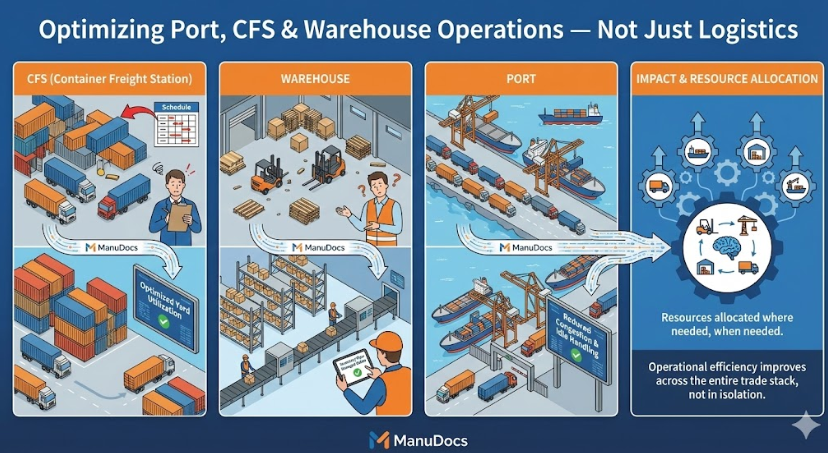
ManuDocs does not automate trucks alone. By fixing data flow and execution: CFSs optimize yard utilization
Warehouses manage inventory flow better
Ports reduce congestion and idle handling
Resources are allocated where needed, when needed
Impact: Operational efficiency improves across the entire trade stack, not in isolation.
7. Fulfilling 9 of the 13 Must-Have Requirements for Port Automation
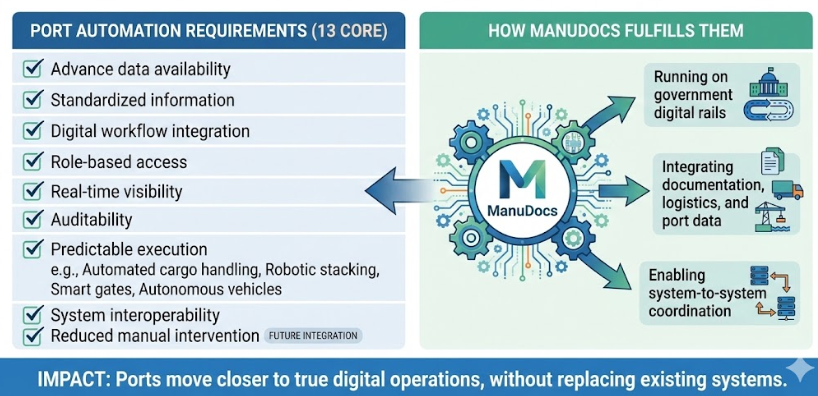
Modern port automation frameworks typically require: Advance data availability
Standardized information
Digital workflow integration
Role-based access
Real-time visibility
Auditability
Predictable execution
System interoperability
Reduced manual intervention
By design, ManuDocs fulfills 9 out of 13 core automation requirements, by: Running on government digital rails
Integrating documentation, logistics, and port data
Enabling system-to-system coordination
Impact: Ports move closer to true digital operations, without replacing existing systems.
8. A Win-Win for Every Stakeholder in the Ecosystem
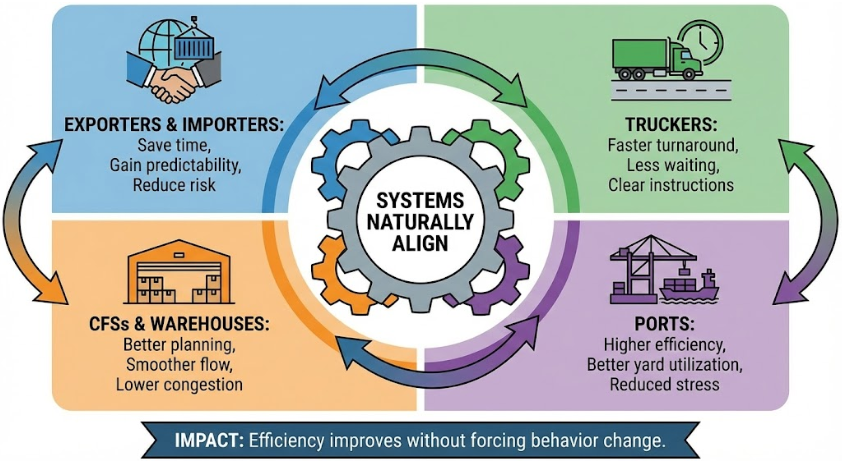
This is not a zero-sum transformation. Exporters & Importers
Save time and money
Gain predictability
Reduce risk
Truckers
Faster turnaround
Less waiting
Clear instructions
CFSs & Warehouses
Better planning
Smoother flow
Lower congestion
Ports
Higher efficiency
Better yard utilization
Reduced operational stress
Impact: Efficiency improves without forcing behavior change — systems naturally align.
9. A Practical “Lesson 3” Project in Real-World Automation
ManuDocs is not a theoretical automation experiment. It is: A real-world execution system
Built on existing national infrastructure
Designed to work with current stakeholders
Focused on operational outcomes
In that sense, ManuDocs represents a Lesson-3 level project: Moving from digitization → coordination → optimization
Conclusion: The Impact Goes Beyond a Platform
By solving execution and data flow: Logistics becomes predictable
Ports become efficient
CFSs become organized
Trade becomes scalable
ManuDocs is not just automating logistics. It is automating coordination — the most expensive missing layer in Indian trade. That is the real impact we are creating.