Saving Time, Cutting Costs, and Removing Friction
Solving the Execution Problem Is Not About Vision — It’s About Outcomes
Saving Time, Cutting Costs, and Removing Friction: The Real Value ManuDocs Delivers to Exporters & Importers
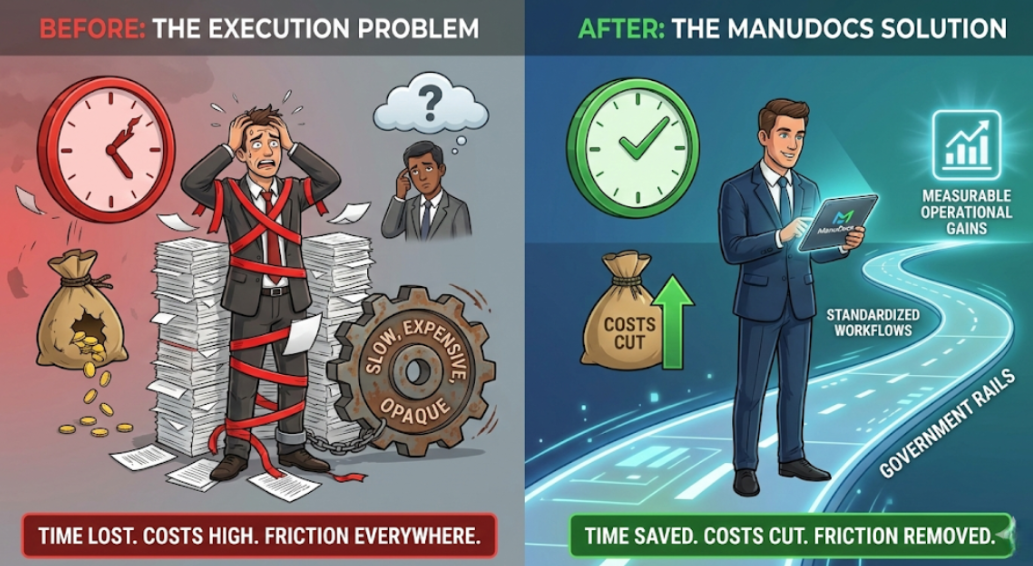
Solving the Execution Problem Is Not About Vision — It’s About Outcomes Once buyers, sellers, and intelligence are in place, exporters and importers face a hard reality: Global trade execution is slow, expensive, opaque, and error-prone. ManuDocs does not approach this as an abstract reform problem. We approach it as a time, cost, and efficiency problem — because that is what exporters, importers, and agents actually feel on the ground. By digitizing execution on government rails and standardizing workflows, ManuDocs delivers measurable operational gains.'
1. Up to 80% Time Savings Across the Export–Import Process
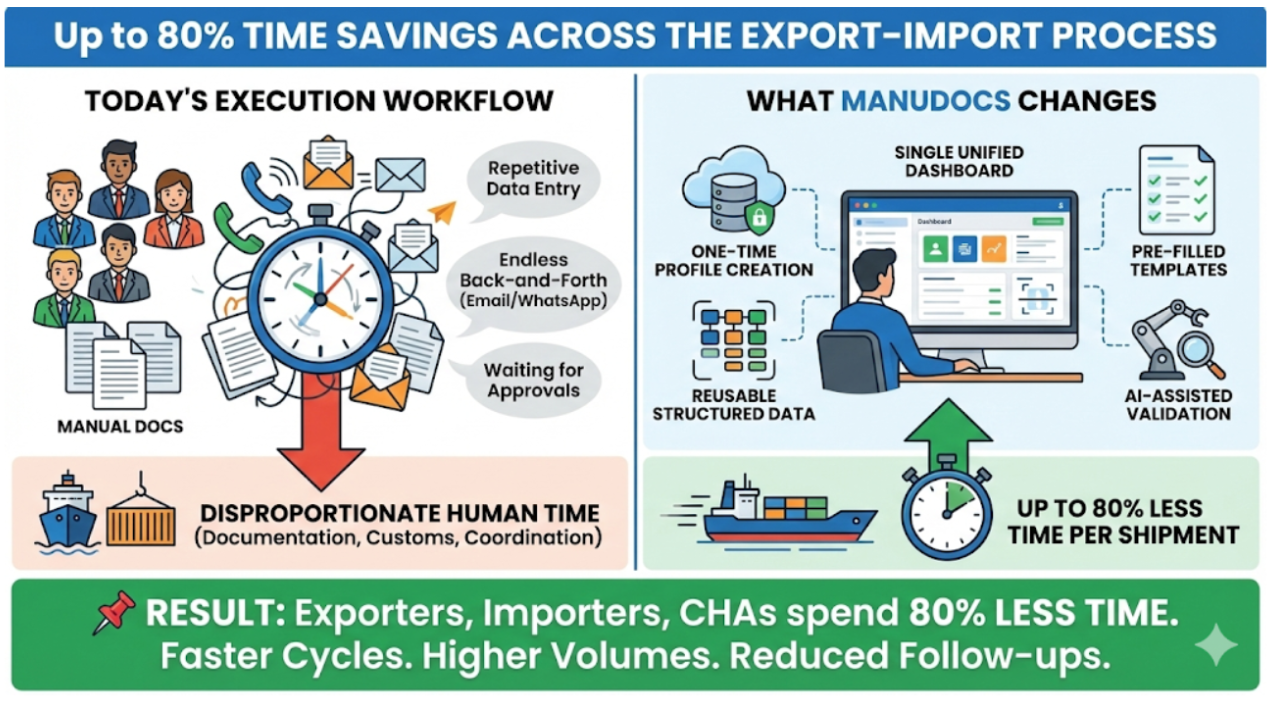
Today’s execution workflow involves: Multiple agents
Repetitive data entry
Manual document preparation
Endless back-and-forth over email and WhatsApp
Waiting for approvals and corrections
Each shipment consumes disproportionate human time, especially for: Documentation
Customs filings
Coordination between parties
What ManuDocs changes One-time profile creation
Reusable structured data
OCR-based document extraction
Pre-filled government-aligned templates
AI-assisted validation before filing
Result: Exporters, importers, and CHAs spend up to 80% less time per shipment on preparation, coordination, and correction. Time saved directly translates into: Faster shipment cycles
Ability to handle higher volumes
Reduced dependency on follow-ups
2. Up to 25% Cost Reduction With Zero Hidden Fees
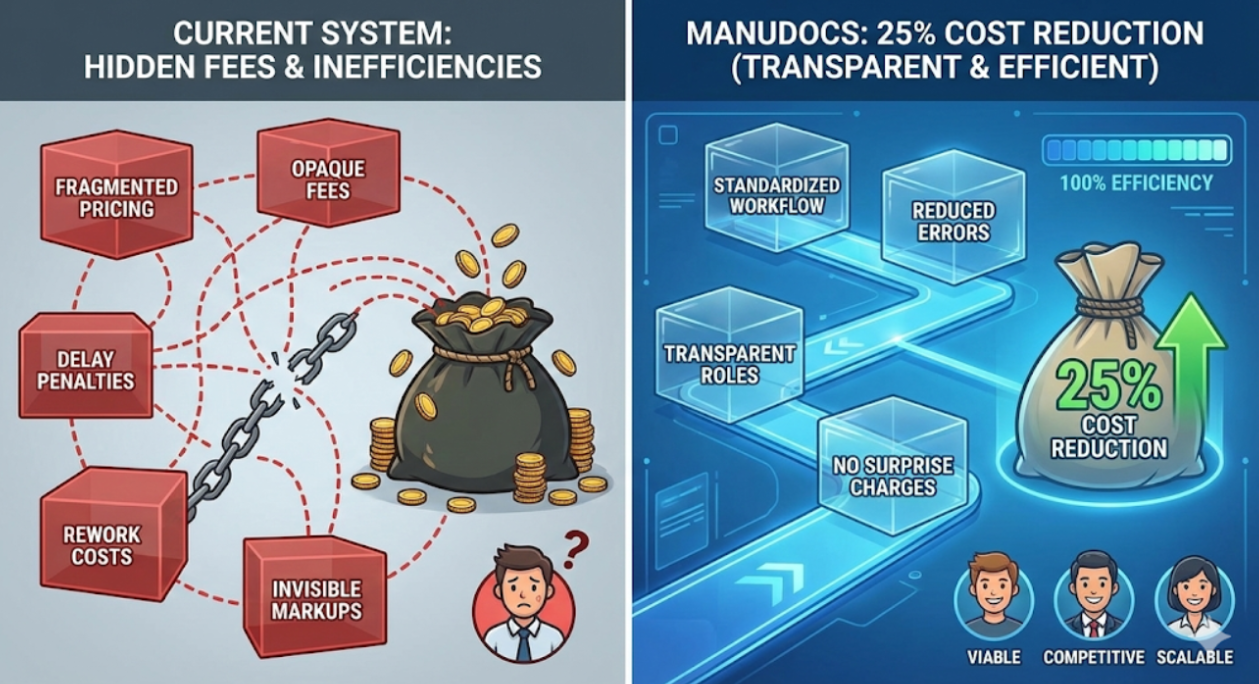
In the current system: Pricing is fragmented
Fees are opaque
Costs rise due to delays, errors, and rework
Agent markups remain invisible
Exporters and importers often pay more than necessary, not because services are expensive — but because inefficiencies compound silently. What ManuDocs changes Standardized workflows reduce rework
Errors and penalties decline
Transparent role-based execution
No hidden intermediaries or surprise charges
Result: Overall execution costs can be reduced by ~25%, purely by eliminating inefficiency and opacity — not by cutting corners. Lower costs make exports: More viable
More competitive
Easier to scale
3. Complete Transparency Across the Trade Lifecycle
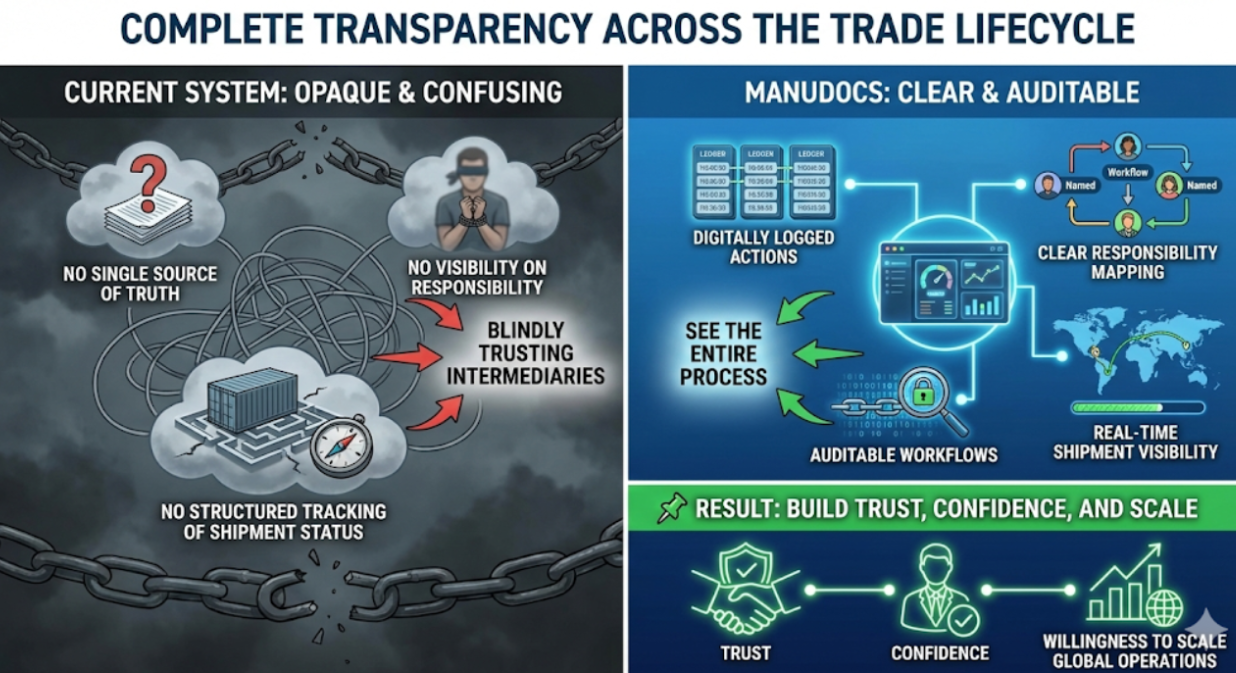
The current system offers: No single source of truth
No visibility on who is responsible for what
No structured tracking of shipment status
ManuDocs replaces this with: Digitally logged actions
Clear responsibility mapping
Real-time shipment visibility
Auditable workflows
Result: Exporters and importers finally see the entire process, instead of blindly trusting intermediaries. Transparency builds: Trust
Confidence
Willingness to scale global operations
4. CHAs Save Time Too — Without Repetitive Manual Work
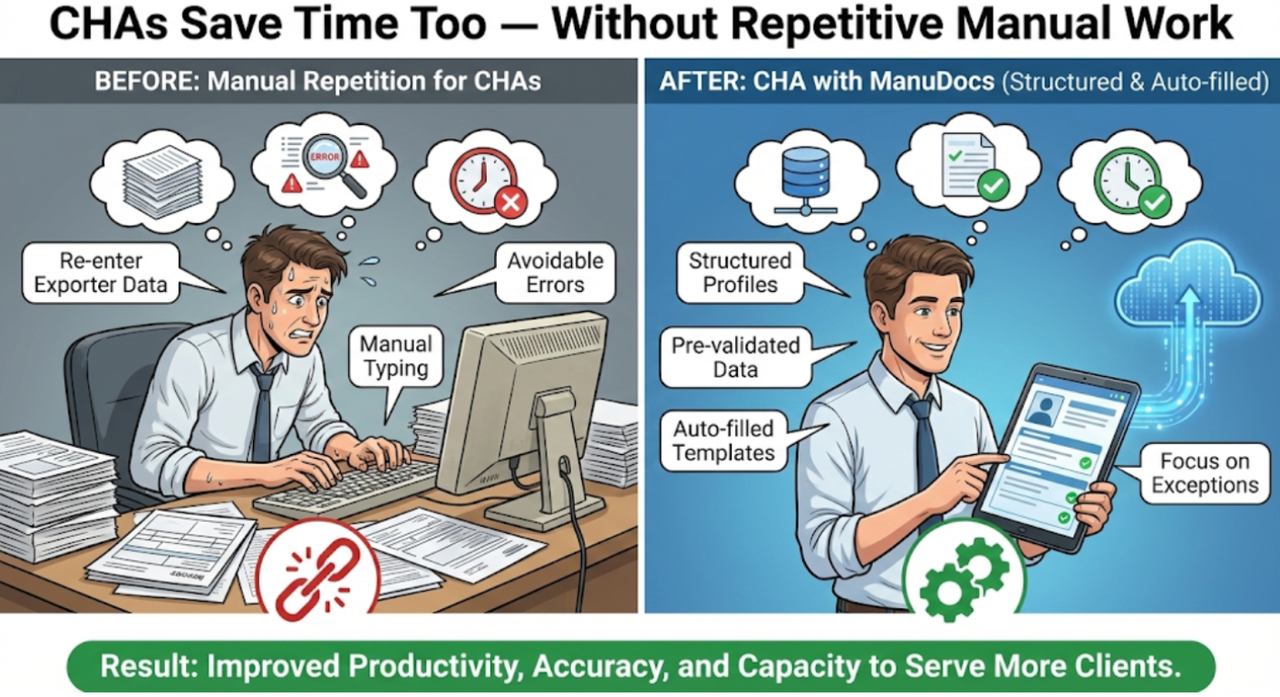
ManuDocs is not anti-agent. It is anti-manual repetition.
Customs House Agents today: Re-enter the same exporter data repeatedly
Manually type product, invoice, and shipment details
Handle avoidable errors caused by inconsistent data
What ManuDocs changes Structured exporter/importer profiles
Pre-validated data fields
Auto-filled templates
Consistent data across shipments
Result: CHAs save time, reduce fatigue, and focus on exception handling, not data entry. This improves: Their productivity
Accuracy of filings
Capacity to serve more clients
5. Eliminating “Garbage In, Garbage Out” at the System Level
One of the classic problems in Indian government systems is: Poor input quality leading to poor output and delays. When data is entered: In different formats
By different people
Without validation
…the system inevitably produces errors. What ManuDocs changes Standardized data structures
Rule-based validation
Government-aligned templates
Single source of truth per business
Result: High-quality input → high-quality output → smoother processing. This improves not just individual shipments, but system-wide efficiency.
6. Fewer Errors → No Cargo Stuck → Faster Customs Clearance
Most customs delays happen due to: Incorrect HS codes
Mismatched values
Missing or inconsistent fields
Last-minute corrections
ManuDocs reduces these risks by: Validating data before filing
Ensuring consistency across documents
Applying rule-aware checks upfront
Result: Fewer rejections
Fewer queries
Faster clearance
Lower detention and demurrage
Speed becomes predictable — not accidental.
7. Directly Supporting India’s $2 Trillion Export Ambition by 2030
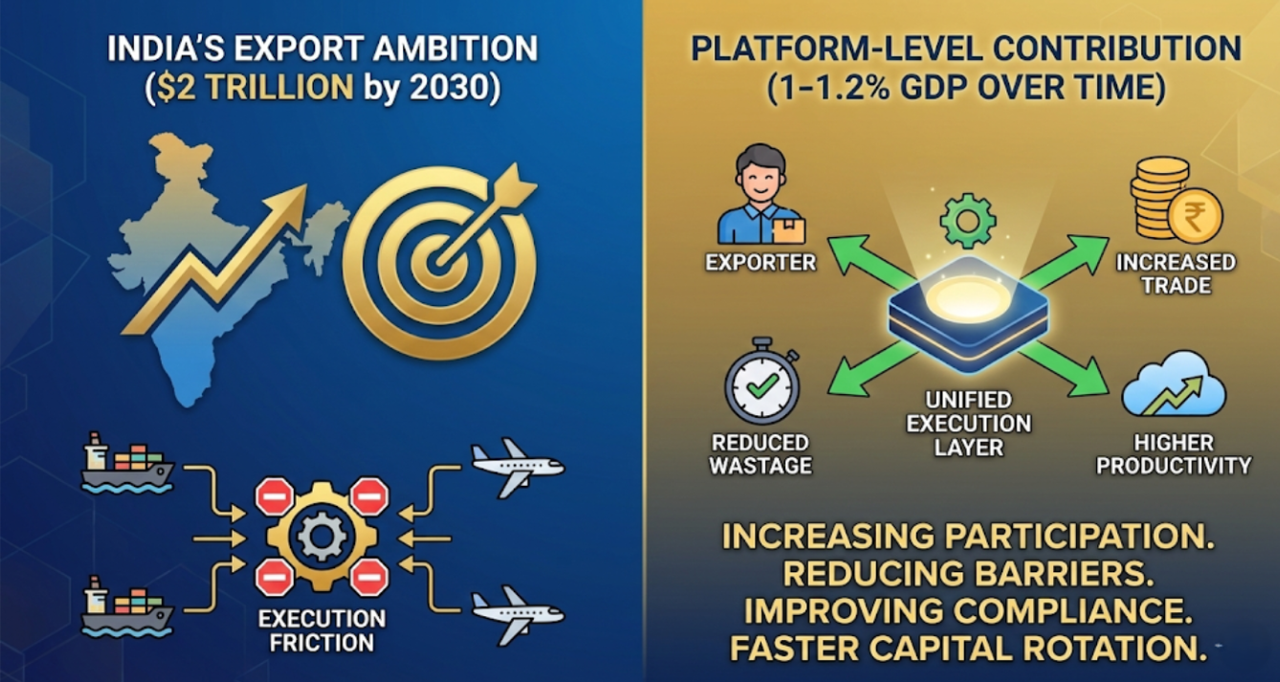
India’s export ambition is not limited by policy intent. It is limited by execution friction. ManuDocs directly contributes by: Increasing exporter participation
Reducing cost and time barriers
Improving compliance quality
Encouraging repeat exports
Result: Trade volumes increase not by force — but by making participation easier and safer. This aligns execution reality with national ambition.
8. A Platform-Level Contribution of 1–1.2% to GDP Over Time
By acting as a unified execution layer: More exporters enter global trade
Existing exporters scale faster
Imports become more efficient
Trade cycles shorten
Even modest efficiency gains across millions of transactions compound rapidly. Result: A single, well-adopted platform can contribute 1–1.2% to GDP through: Increased trade volume
Reduced wastage
Higher productivity
Faster capital rotation
9. Attracting New Exporters & Importers Into Global Business
Fear keeps many businesses out of global trade: Fear of errors
Fear of penalties
Fear of delays
Fear of agents
ManuDocs removes fear by: Making processes visible
Making outcomes predictable
Making support structured
Result: More businesses participate. More businesses stay. More businesses grow.
Conclusion: Efficiency Is the Real Competitive Advantage
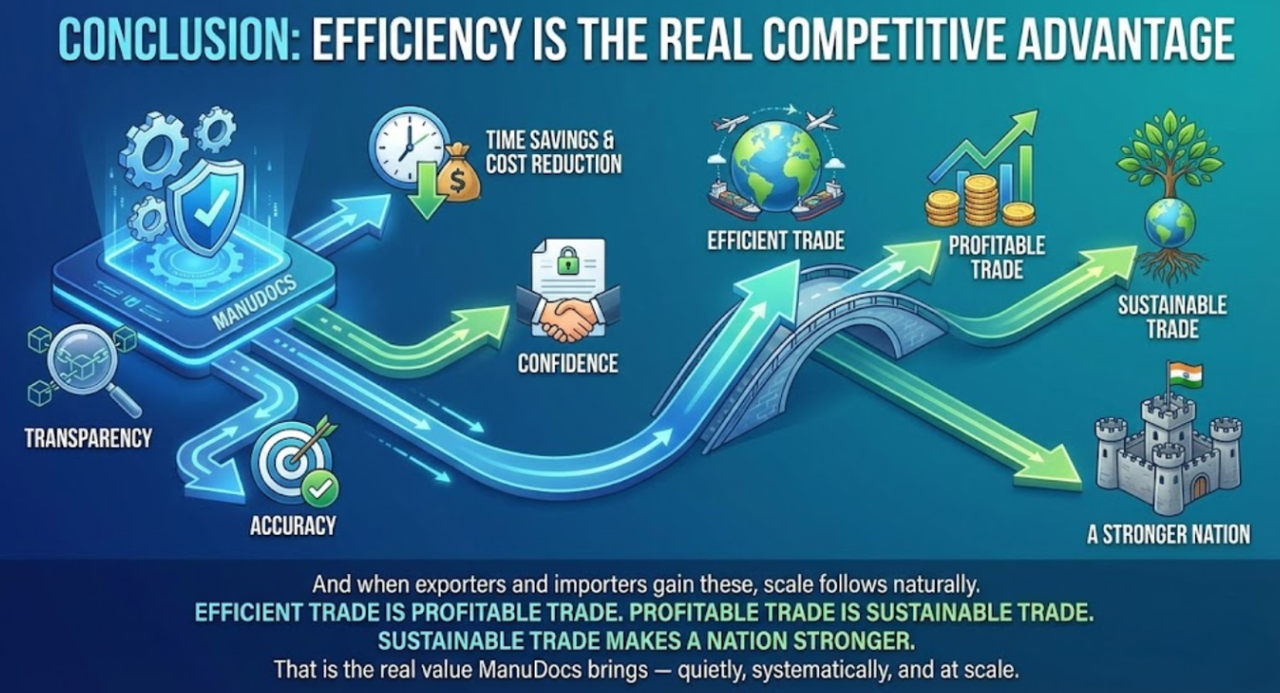
ManuDocs does not promise miracles. It delivers: Time savings
Cost reduction
Transparency
Accuracy
Confidence
And when exporters and importers gain these, scale follows naturally. Efficient trade is profitable trade. Profitable trade is sustainable trade. Sustainable trade makes a nation stronger. That is the real value ManuDocs brings — quietly, systematically, and at scale.