port modernization,low TAT,less friction
From Fragmented Execution to Coordinated Trade Infrastructure
The Impact ManuDocs Will Create by Automating Ports & Trade Execution
From Digitization to Global Competitiveness India has already invested heavily in ports, terminals, customs modernization, and digital rails. The missing piece has been execution orchestration—the layer that converts systems into outcomes. By automating EXIM, logistics, CFSs, and port operations on top of existing government infrastructure, ManuDocs creates impact across Ease of Doing Business, operational efficiency, global competitiveness, and national export growth. This is the impact we are building.
1. National-Level Impact: Ease of Doing Business & Export Growth
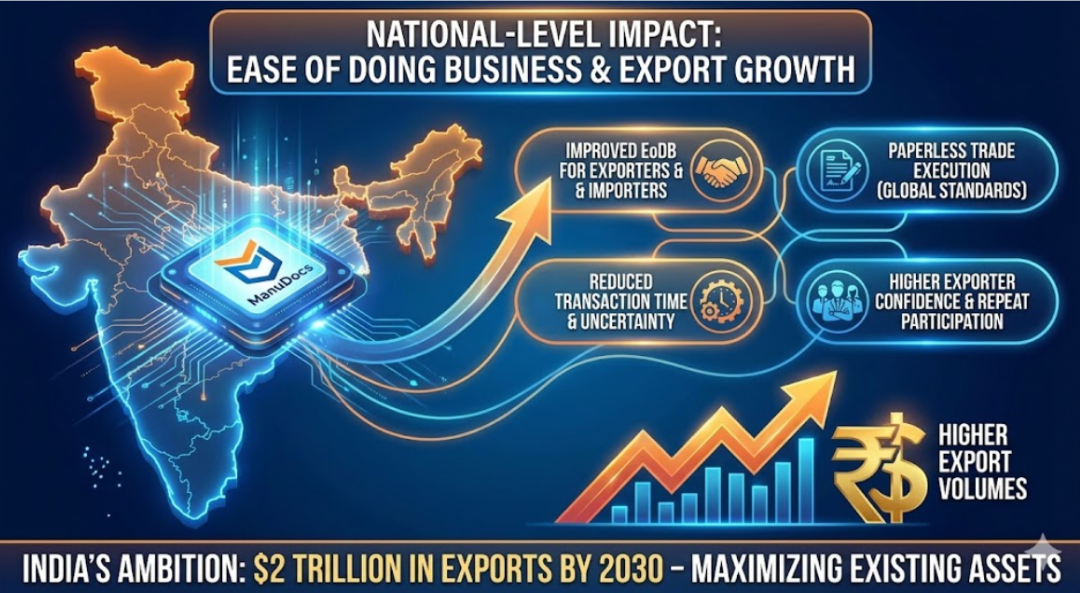
By enabling paperless, predictable, and faster trade execution, ManuDocs directly contributes to India’s macro trade goals. Key national outcomes Significant improvement in Ease of Doing Business (EoDB) for exporters and importers
Reduced transaction time and uncertainty across the EXIM lifecycle
Paperless trade execution aligned with global standards
Higher exporter confidence and repeat participation
Impact: Lower friction → higher participation → higher export volumes. This directly supports India’s ambition of $2 trillion in exports by 2030, not by adding more infrastructure, but by maximizing the performance of existing assets.
2. Global Port Competitiveness & Benchmark Alignment
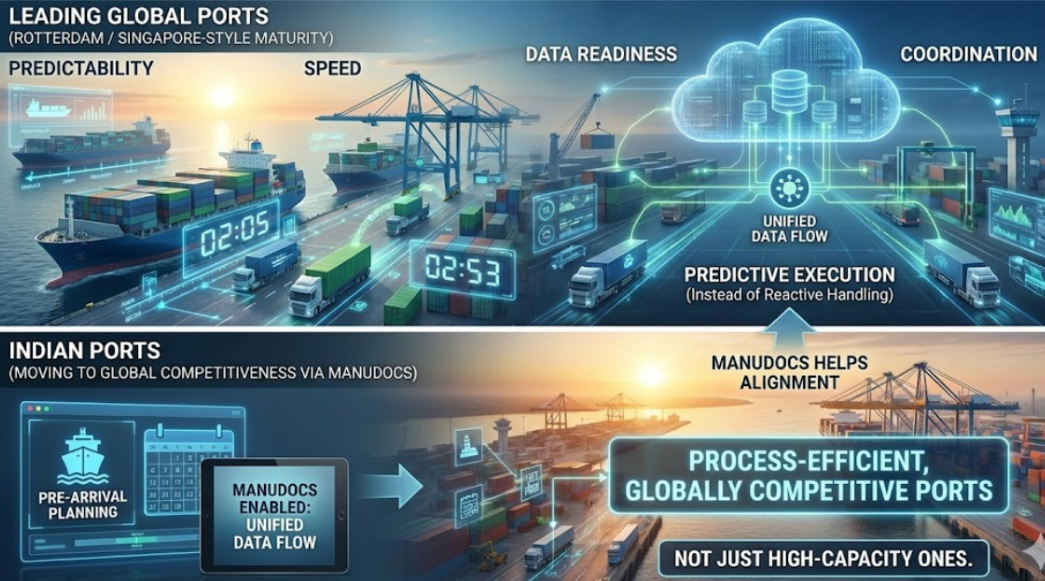
Leading global ports compete not just on size, but on: Predictability
Speed
Data readiness
Coordination
ManuDocs helps Indian ports move closer to Rotterdam / Singapore-style operating maturity by enabling: Pre-arrival planning
Unified data flow
Predictive execution instead of reactive handling
Impact: Indian ports become process-efficient, globally competitive ports, not just high-capacity ones.
3. Operational Performance Impact (Core Port KPIs)
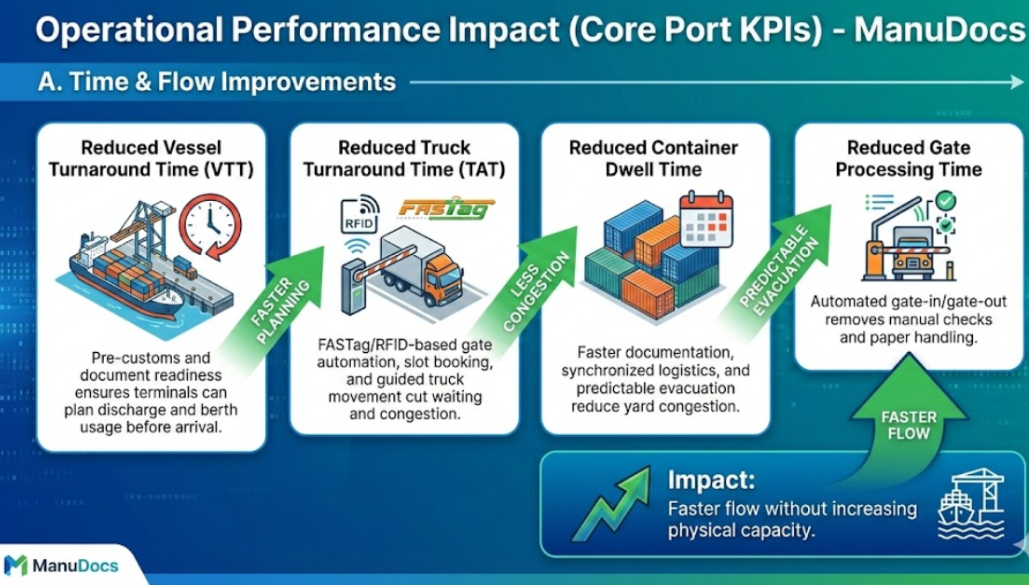
By automating documentation, logistics synchronization, and gate operations, ManuDocs improves every critical operational KPI. A. Time & Flow Improvements Reduced Vessel Turnaround Time (VTT) Pre-customs and document readiness ensures terminals can plan discharge and berth usage before arrival.
Reduced Truck Turnaround Time (TAT) FASTag/RFID-based gate automation, slot booking, and guided truck movement cut waiting and congestion.
Reduced Container Dwell Time Faster documentation, synchronized logistics, and predictable evacuation reduce yard congestion.
Reduced Gate Processing Time Automated gate-in/gate-out removes manual checks and paper handling.
Impact: Faster flow without increasing physical capacity.
4. Improved Asset Utilization & Terminal Productivity
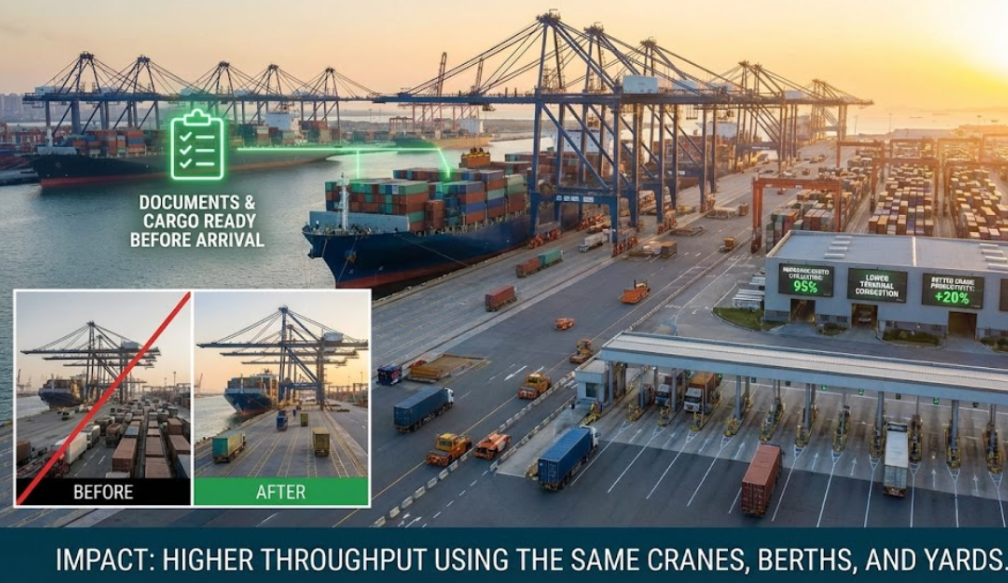
When documents and cargo are ready before arrival, ports can plan better. This leads to: Improved berth utilization
Lower terminal congestion
Better crane productivity due to smoother yard flow
Reduced idle time for equipment and manpower
Impact: Higher throughput using the same cranes, berths, and yards.
5. Cost Reduction: Detention, Demurrage & Variability
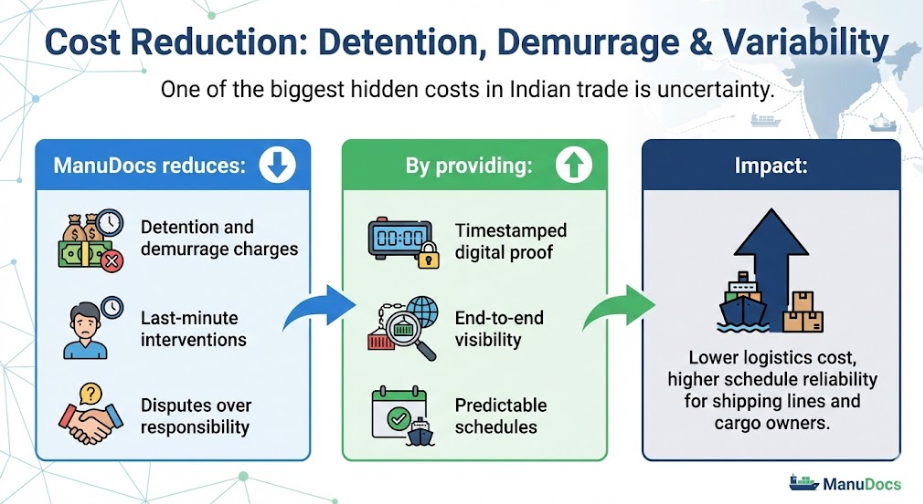
One of the biggest hidden costs in Indian trade is uncertainty. ManuDocs reduces: Detention and demurrage charges
Last-minute interventions
Disputes over responsibility
By providing: Timestamped digital proof
End-to-end visibility
Predictable schedules
Impact: Lower logistics cost, higher schedule reliability for shipping lines and cargo owners.
6. Cargo, Yard, CFS & Warehouse Optimization
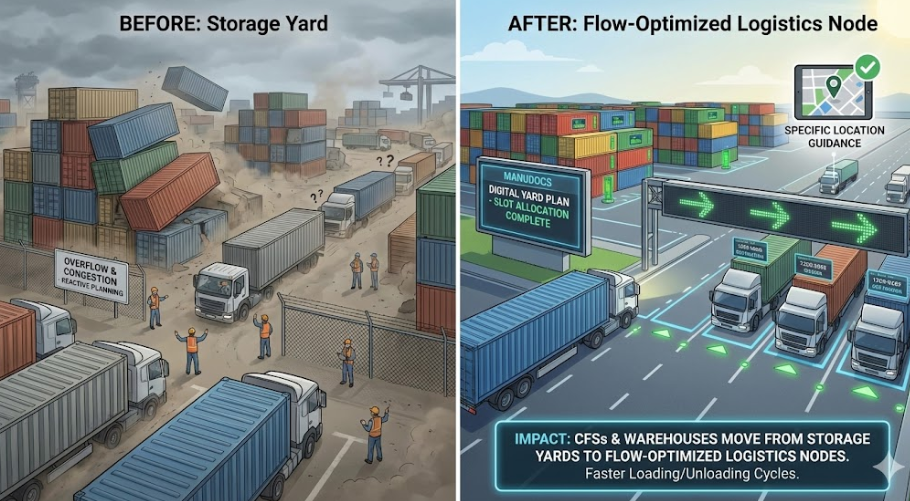
ManuDocs enables online booking of storage and yard capacity, allowing: Better CFS and warehouse utilization
Planned allocation of yard space
Reduced overflow and congestion
Digital yard planning enables: Slot allocation before truck arrival
Specific location guidance for truckers
Faster loading/unloading cycles
Impact: CFSs and warehouses move from storage yards to flow-optimized logistics nodes.
7. Fully Automated Gate & Traffic Management
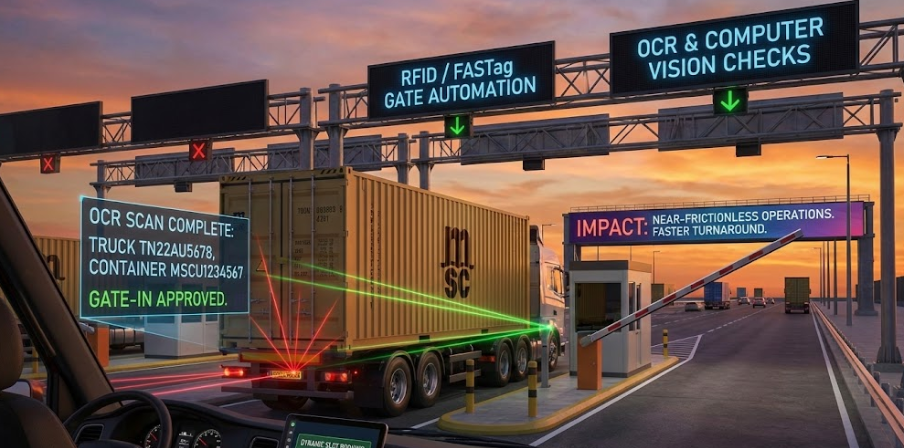
ManuDocs enables: RFID / FASTag-based gate automation
OCR & computer vision-driven gate checks
Dynamic truck slot booking
Automatic gate-in / gate-out
Impact: Near-frictionless gate operations
Reduced queues inside and outside ports
Faster turnaround for trucks
8. End-to-End Digital Documentation & Compliance
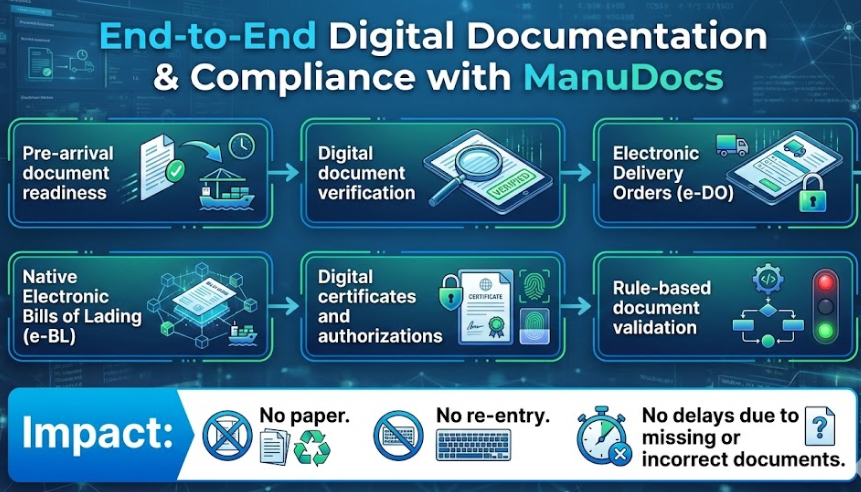
ManuDocs automates: Pre-arrival document readiness
Digital document verification
Electronic Delivery Orders (e-DO)
Native Electronic Bills of Lading (e-BL)
Digital certificates and authorizations
Rule-based document validation
Impact: No paper. No re-entry. No delays due to missing or incorrect documents.
9. Financial & Payment Automation
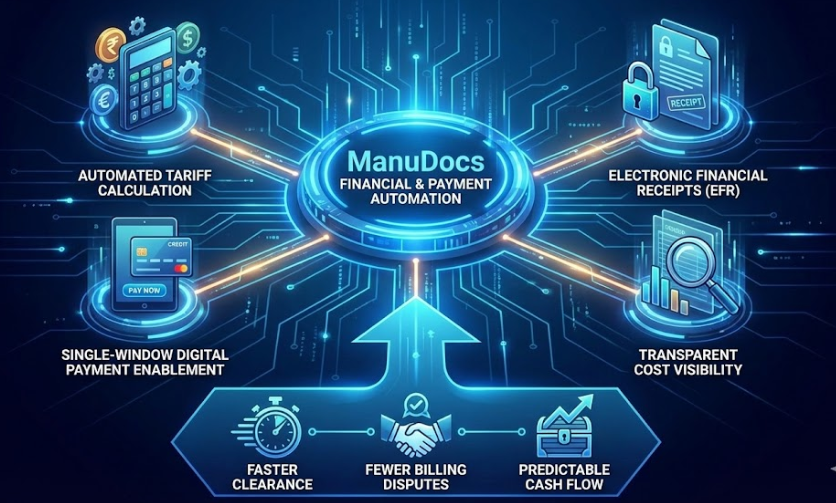
By structuring trade and cargo data digitally, ManuDocs enables: Automated tariff calculation
Single-window digital payment enablement
Electronic Financial Receipts (EFR)
Transparent cost visibility
Impact: Faster clearance, fewer billing disputes, and predictable cash flow.
10. A True Single Maritime Window (Execution, Not Just Data)
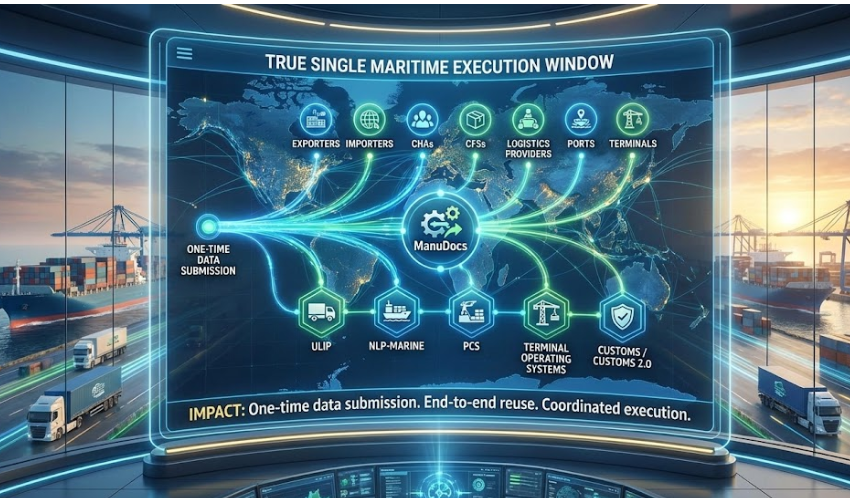
By eliminating duplicate data entry and orchestrating a single validated dataset across: Exporters
Importers
CHAs
CFSs
Logistics providers
Ports
Terminals
…and integrating with: ULIP
NLP-Marine
PCS
Terminal Operating Systems
Customs / Customs 2.0
ManuDocs converts India’s digital rails into a true Single Maritime Execution Window. Impact: One-time data submission. End-to-end reuse. Coordinated execution.
11. Alignment with Maritime India Vision 2030
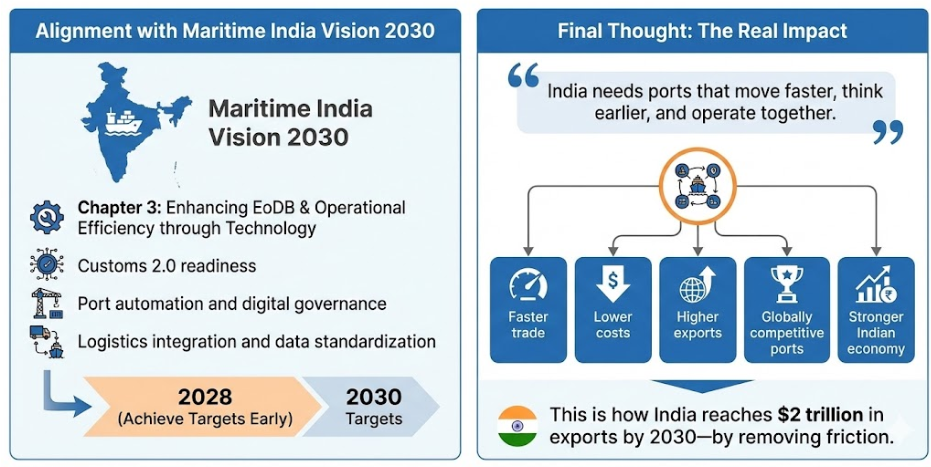
ManuDocs is fully aligned with Maritime India Vision 2030, especially: Chapter 3: Enhancing EoDB & Operational Efficiency through Technology
Customs 2.0 readiness
Port automation and digital governance
Logistics integration and data standardization
By enabling 9+ must-have port automation capabilities, ManuDocs helps India achieve 2030 targets earlier—potentially by 2028.
Final Thought: The Real Impact
India does not need more ports alone. It needs ports that move faster, think earlier, and operate together. By automating EXIM, logistics, CFSs, and ports as one coordinated system, ManuDocs transforms digitization into real performance. That is the impact we are creating: Faster trade
Lower costs
Higher exports
Globally competitive ports
And a stronger Indian economy
This is how India reaches $2 trillion in exports by 2030—not by adding complexity, but by removing friction.