Eliminating Manual Agent Dependency by Running on Government Digital Rails
From Fragmented Agent Dependency to Unified Digital Trade Execution
How ManuDocs Is Eliminating Manual Agent Dependency by Running on Government Digital Rails
From Fragmented Agent Dependency to Unified Digital Trade Execution
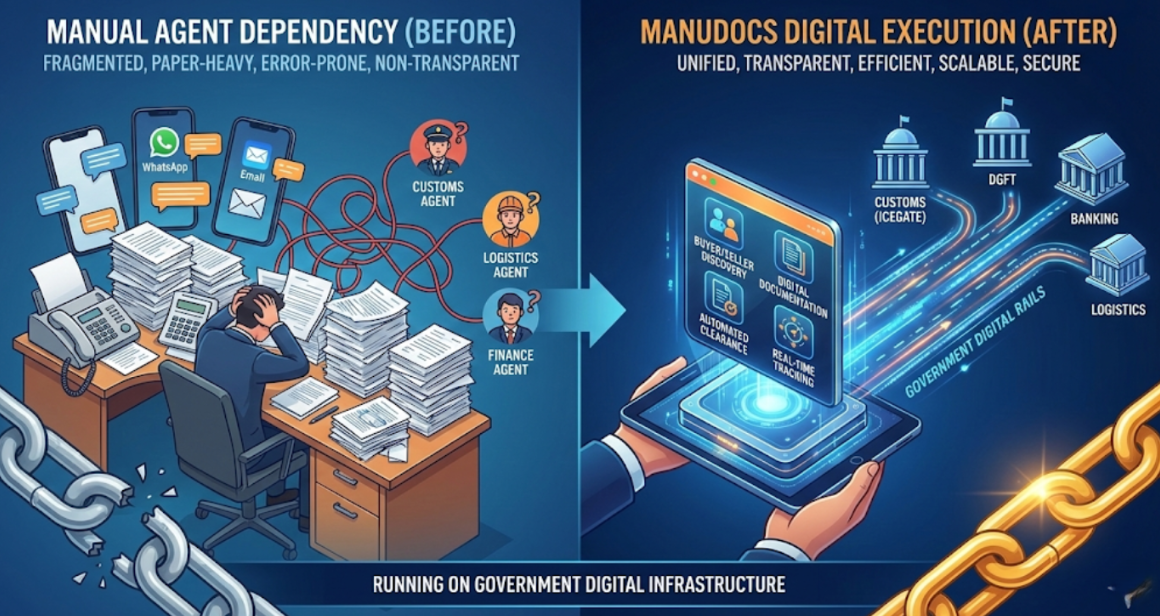
Once exporters and importers find buyers, suppliers, and market intelligence, they face the next biggest bottleneck in global trade: Heavy dependence on manual agents, disconnected workflows, delays, errors, and zero transparency. Today’s export–import execution system in India is: Agent-driven
Paper-heavy
WhatsApp- and email-based
Non-transparent
Error-prone
This dependency increases: Clearance delays
Compliance risks
Penalties
Costs
And most importantly, fear of scaling global trade
ManuDocs solves this problem not by bypassing the system, but by building on top of India’s official digital trade infrastructure.
Learning from India’s Payment Revolution: Build on Public Rails
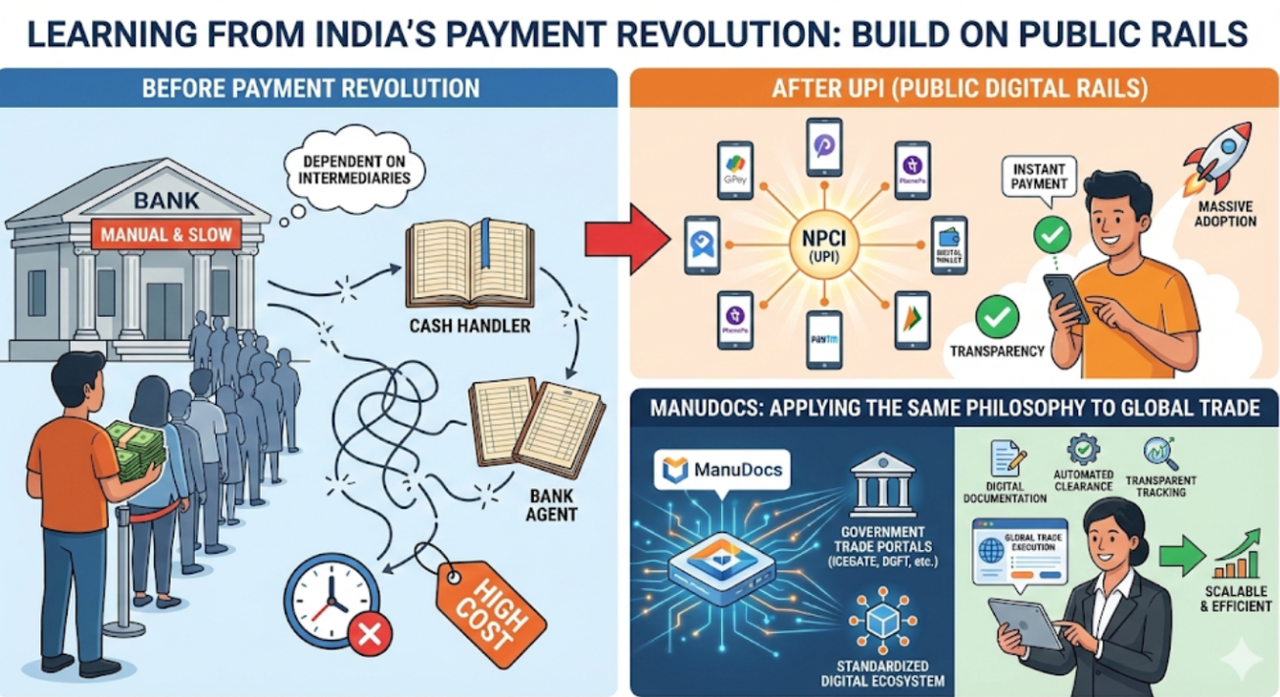
India already has a proven model for large-scale transformation. Before digital payments: People depended on banks, cash handlers, intermediaries
Payments were slow, costly, and manual
Then came National Payments Corporation of India (NPCI). By building UPI as a public digital rail, India enabled: Multiple private platforms
Instant payments
Transparency
Massive adoption
The key lesson: Don’t replace the ecosystem. Standardize and digitize it using public infrastructure. ManuDocs applies the same philosophy to global trade execution.
Running ManuDocs on India’s National Logistics & Trade Rails
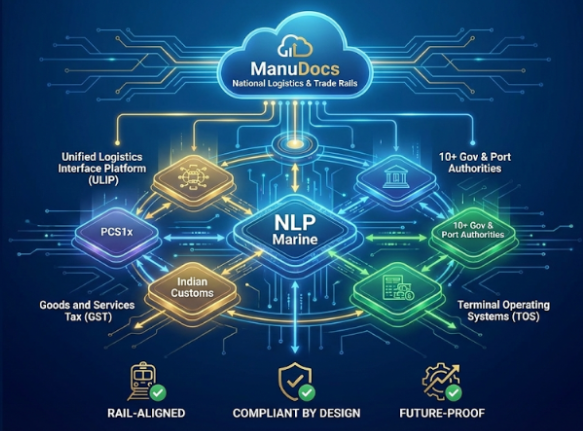
ManuDocs is designed to operate on top of official government systems, not parallel to them. At the core is NLP Marine, which is already integrated with: Unified Logistics Interface Platform (ULIP)
PCS1x
Indian Customs
Goods and Services Tax (GST)
Terminal Operating Systems (TOS)
10+ participating government and port authorities
This means ManuDocs is rail-aligned, compliant by design, and future-proof.
Role-Based Digital Participation for the Entire Trade Ecosystem
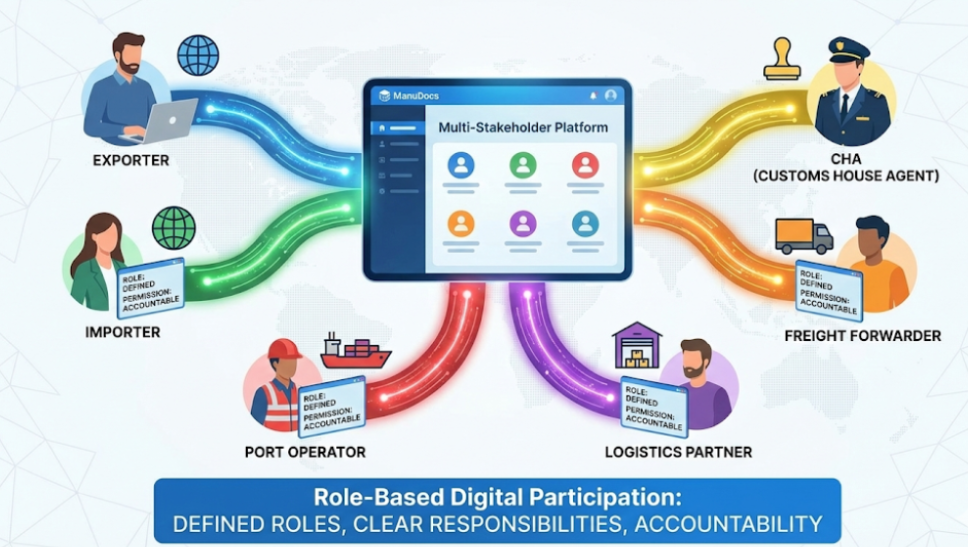
ManuDocs is not exporter-only or agent-only. It is a multi-stakeholder execution platform with role-based access. On ManuDocs: Exporters
Importers
Customs House Agents (CHAs)
Freight forwarders
Logistics partners
Port operators
…each get defined digital roles, permissions, and responsibilities. This removes ambiguity and ensures accountability at every step.
AI-Assisted Filing Built on Indian Trade Rules
At the heart of ManuDocs is rule-aware automation. Our AI models are trained on: DGFT rules and procedures (Directorate General of Foreign Trade)
Customs regulations
Port and shipping norms
GST compliance logic
Historical filing patterns
Instead of exporters manually coordinating with multiple agents: ManuDocs assists in preparing shipping bills
Validates data before submission
Flags errors before customs filing
Reduces rejections, penalties, and delays
Automation here is compliance-first, not shortcut-driven.
Intelligent Document Management with OCR & Templates
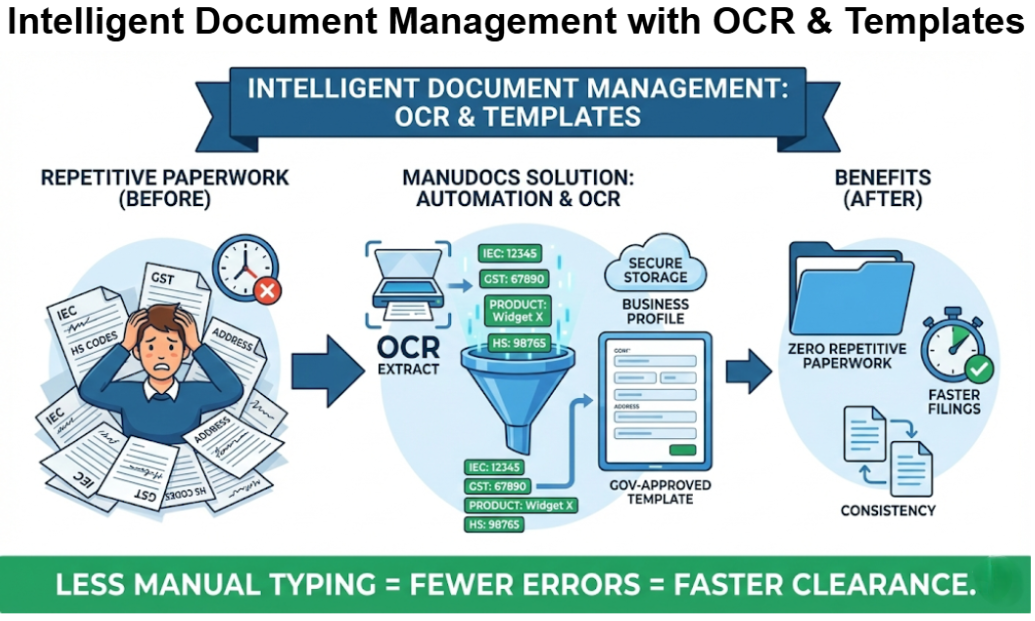
Export–import documentation repeatedly uses the same data: Company details
IEC
GST
Product descriptions
HS codes
Addresses
ManuDocs solves this by: Creating a persistent business profile
Securely storing commonly used documents
Extracting data via OCR
Mapping fields into standard government-approved templates
This enables: One-time data entry
Zero repetitive paperwork
Faster filings
Consistency across shipments
Less manual typing = fewer errors = faster clearance.
Flexible Filing Options: Control or Assisted Execution
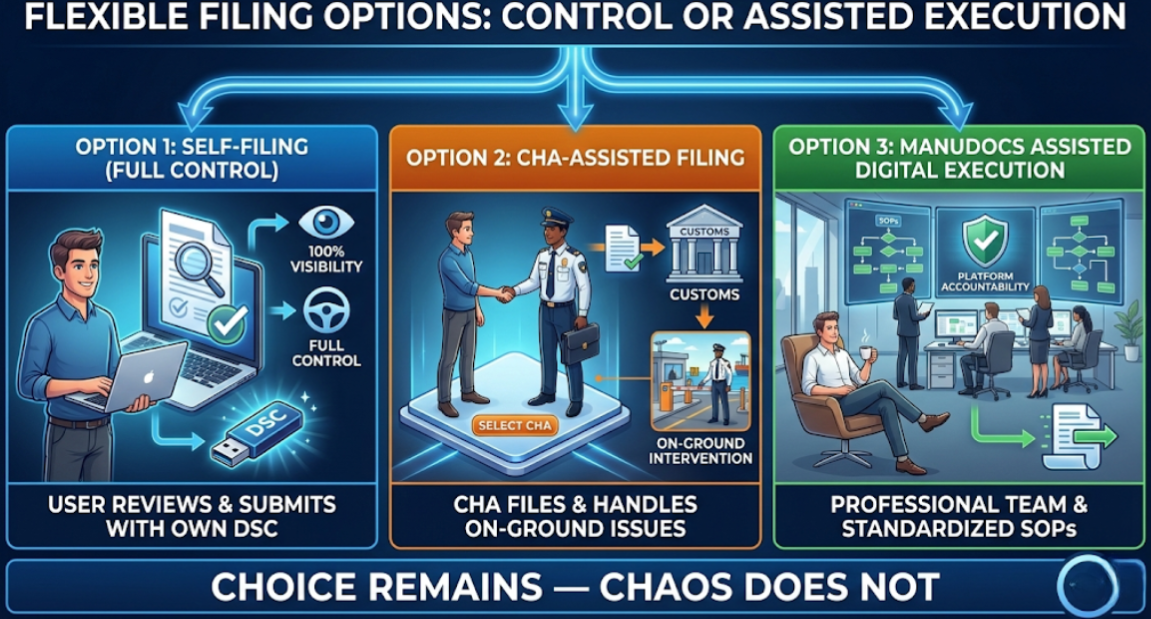
ManuDocs does not remove choice — it removes friction. Exporters and importers can choose: Option 1: Self-Filing (Full Control) Use their own DSC
Review every document
Submit with 100% intent and visibility
Option 2: CHA-Assisted Filing Choose a CHA on the platform
CHA files on their behalf
CHA handles on-ground customs interventions if cargo is stuck
Option 3: ManuDocs Assisted Digital Execution A professional execution team handles filings
Standardized SOPs
Platform-level accountability
No dependency on unstructured agents
Choice remains — chaos does not.
End-to-End Transparency & Shipment Tracking
With all workflows unified: Every shipment is digitally tracked
Status updates are visible in real time
Responsibilities are clearly logged
Communication moves from WhatsApp to structured workflows
Exporters and importers gain: Predictability
Auditability
Confidence to scale
Transparency is no longer a privilege — it becomes default.
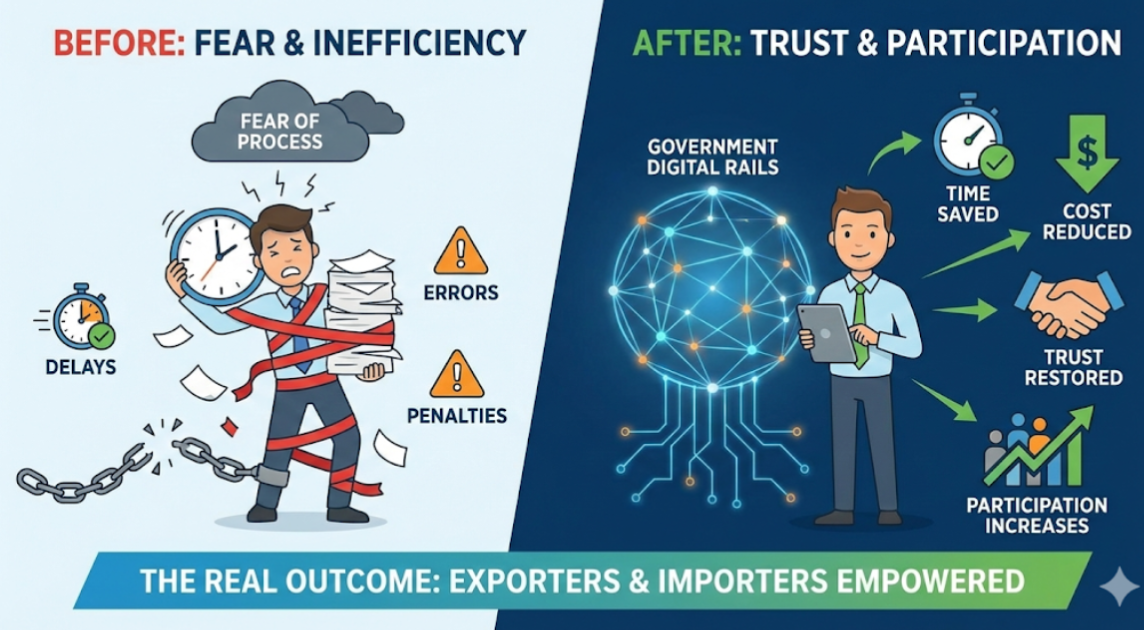
The Real Outcome: Time Saved, Cost Reduced, Trust Restored
By running on government rails and digitizing execution: Delays reduce
Errors drop
Penalties decline
Agent markups become visible
Decision-making improves
Most importantly: Exporters and importers stop fearing the process. And when fear is removed, participation increases.
Conclusion: Digitizing Execution Is the Missing Link
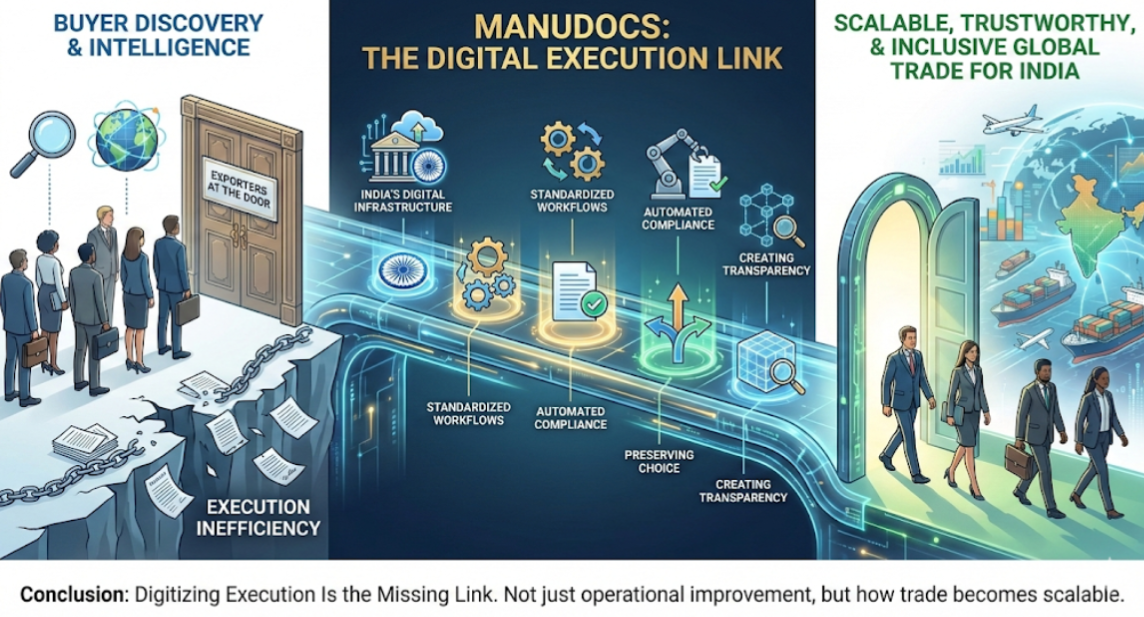
Buyer discovery and intelligence bring exporters to the door. Execution efficiency decides whether they walk through it. ManuDocs solves the execution problem by: Building on India’s official digital trade infrastructure
Standardizing workflows
Automating compliance
Preserving choice
Creating transparency
This is not just operational improvement. This is how global trade becomes scalable, trustworthy, and inclusive for India.